
















The Compounding Economics of CHIP

Velocity builds mass. Mass funds CHIP, and scales the gravity of its USD.AI network.
For followers of USD.AI, product-market fit was the 1st hard question, and the origination engine built in Allo Game Season 2 demonstrated that PMF moment. The 2nd hard question, for CHIP holders and sUSDai depositors, is just as simple to state: when the protocol earns, where does the revenue go, and what reaches CHIP?
Now that CHIP governance is live, this post answers it line by line. The companion video walks through the same material and the heuristic developed to accommodate the heavy offchain and institutional nature of the business, in collaboration with the onchain network built around the settlement layer.
The CHIP protocol (previously USD.AI protocol) is sUSDai, USDai and the contracts that fund and settle every loan, on terms set by CHIP holders. CHIP Foundation (previously USD.AI Foundation) stewards that onchain side. USD.AI Inc. (previously Permian Labs) builds offchain products that make the protocol’s loans cheaper and faster to produce. Each earns a different kind of revenue. That difference decides where the revenue goes, and it is how alignment is demonstrated without sacrificing growth.
One rule organizes every decision going forward: Velocity builds mass. Mass funds CHIP. Revenue earned on velocity, each time a loan is made and sold, is reinvested against the friction that slows the loans (sUSDai) & stablecoin supply (USDai) down. Revenue earned on mass, every dollar of USDai and sUSDai outstanding, is routed to CHIP.
Proposal summary: The proposal is for all sUSDai net interest margin (NIM), net of CHIP Foundation costs, to go to programmatic CHIP purchases from today. Origination fees and gain on sale (the margin earned when a seasoned loan is sold through GLX) are mostly reinvested in making the next loan cheaper and faster, with some discretionary CHIP purchases. 40% of gain on sale goes to the Yield Reserve, which defends the 7% CHIP Hurdle Rate for sUSDai as loans are sold. USDai NIM is switched off today and is expected to become the largest source of CHIP purchases as credit outstanding grows over time, and more ecosystem products are built around cash settlement of all things compute (platform sales/services). The long-term objective is a net deflationary CHIP: protocol purchases exceeding new issuance.
Creating Gravity: New Loans Add Mass to the Protocol, and a Stablecoin for Compute Settlement Is the North Star
The initial product of the CHIP protocol is a new GPU financing loan, where a neocloud borrows against its GPUs on standard terms. The loan is funded from sUSDai, and its payments settle in USDai. CHIP holders set the terms every loan must meet: collateral eligibility, rate tiers, fees, and the underwriting parameters being set in a separate proposal. CHIP Foundation stewards the contracts that hold and settle those loans.
The loan is the initial product. The stablecoin is the North Star. Every loan originated through sUSDai is denominated in USDai and settles in it. So every loan adds to the mass of USDai and sUSDai outstanding, and the mass is where the durable revenue lives: NIM on USDai & sUSDai. Finance the machines, the machines adopt the money, and that dollar will settle everything in compute & AI. Mass is what pulls & compounds the next loan in.
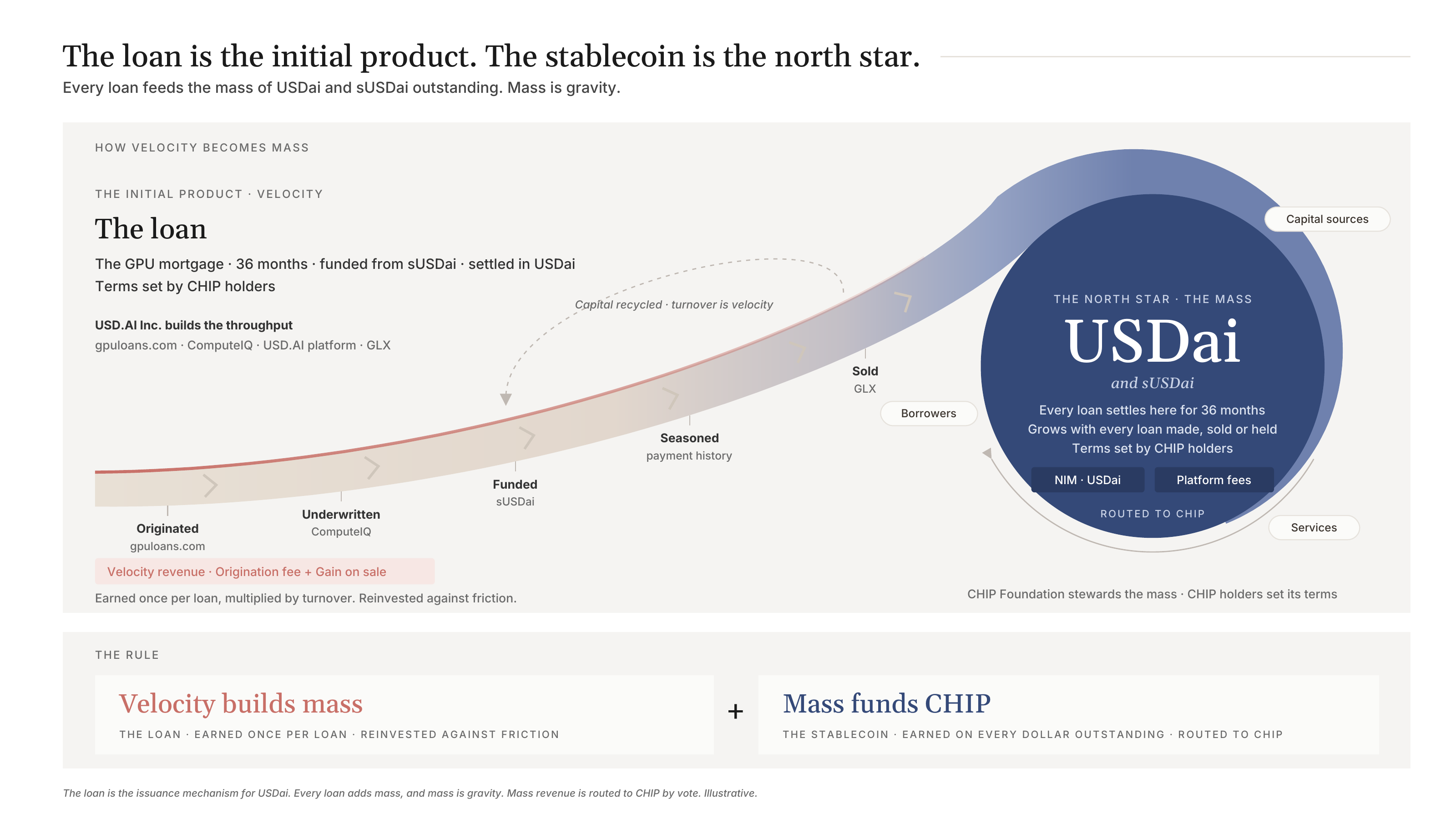
Around that initial product, USD.AI Inc. builds the complementary products that raise the velocity of the loan throughput and the quality of new loans. Each one sits on one stage of a loan’s life:
- Origination (new loan): gpuloans.com brings borrowers to the protocol. This is typically the most expensive part of any debt business: “finance” is consistently one of the most expensive cost-per-click (CPC) categories in paid search.
- Underwriting: Compute IQ standardizes how each loan is assessed, with a rubric trained on prior deals. The education costs are high due to the nascency of this sector compared to student loans, mortgages, etc.
- Distribution (loan sale): GLX, the GPU Loans Exchange, sells seasoned loans to institutional buyers so the same capital can be lent again. This is the newest business line of USD.AI Inc., with early adoption by multi-billion-dollar funds, banks and institutions, but many products must still be built to meet their compliance and underwriting rigor.
- Platform (servicing & value bundling): Loan servicing, the deal manager and the borrower portal today; payments, telemetry, hedging, and other services bundled into settlement over time.
None of these products is the protocol, as they almost all exist offchain to make the protocol work. All of them exist to make the protocol’s loans cheaper, faster and better, so that more loans are funded, held and settled onchain.
That distinction decides where revenue goes. The fees earned offchain (origination fees, the reinvested share of gain on sale, platform services) are earned by USD.AI Inc. They pay for the products that shrink the cost of the next loan. The revenue earned onchain (NIM on sUSDai, and in time NIM on USDai) is the protocol’s. CHIP holders direct it, and the proposal is to direct it to CHIP purchases.
Not every dollar earned in the ecosystem is protocol revenue: there are significant costs in just the origination and structuring of a loan (upward of millions of dollars per loan at times), and the framework should be judged on its defined allocations rather than on the total. But the offchain fees do reach CHIP, one step removed. They are what grow the mass of USDai and sUSDai outstanding, and the mass is the revenue base that CHIP purchases are drawn from. It is the only base that compounds. Sending the fees to CHIP today would buy CHIP once. Spending them on velocity adds mass every year after, and lets the protocol capture the most powerful force in finance: compounding.
The Trade-off: Reinvest for Compounding Velocity, and Purchase CHIP for Alignment
The first post in this series argued that financing the next 10,000 neoclouds needs a far lower fixed cost per loan. Capital alone does not solve it. Each borrower still has to be found, underwritten, documented, funded and connected to a long-term capital source. The same constraint should shape where revenue goes.
Revenue can do two things. It can be reinvested to lower the cost of the next loan and raise future revenue. Or it can purchase CHIP today, so that the protocol relies less on emissions, but revenue stays where it is. Both are good uses. The question is sequencing, and the answer depends on where each dollar is earned.
CHIP purchases are a steady-state mechanism, and every dollar used for CHIP cannot be used for new talent, new products and new features. They make sense once a function can sustain itself and earns more than it needs. Applying that policy to every function while the infrastructure is still being built would starve the system that produces and multiplies the revenue. The distinction matters for the scale of the network and for the credibility of its decentralization.
A dollar reinvested in a stage that is still expensive does more than a dollar of work. It lowers the cost of every loan that follows. Lower cost raises turnover. Turnover multiplies every fee earned on motion. Amazon’s 1997 shareholder letter committed to investing in customers and infrastructure and judging each dollar by its results; the company then ran close to zero reported profit for most of two decades while it built fulfillment, Prime and AWS. Google’s 2004 founders’ letter explained why it would fund long-term opportunities even when they reduced near-term results. Both reinvested for years before they spent the cash on anything else, and neither would have reached its scale by paying out early. The lesson is about how infrastructure gets built (it does not make CHIP equivalent to shares in those companies, or imply comparable outcomes).
The opposite mistake is just as real. A protocol that reinvests everything leaves CHIP, the asset that sets its terms, disconnected from the revenue those terms produce. So the rule is not “reinvest now, purchase later”. It is: purchase from the stages that are finished, reinvest in the stages that are not, and do both at once while the protocol keeps lending and compounding.
The chart below shows how the current setup has evolved. Every loan passes through five cost centers: origination, underwriting, process, settlement and distribution. The brown bars are friction that culminates to the total fixed cost per loan. They are the time, money and cost each stage takes today. Some of that work is essential. Most of its expense comes from repeating bespoke processes, because the products and standards that would make them repeatable do not exist yet. The aim is to remove the repeated work, not the controls. Friction decelerates the protocol: every month and every dollar inside a bar is a month and a dollar in which capital is not moving. It caps velocity, and velocity is what builds mass.
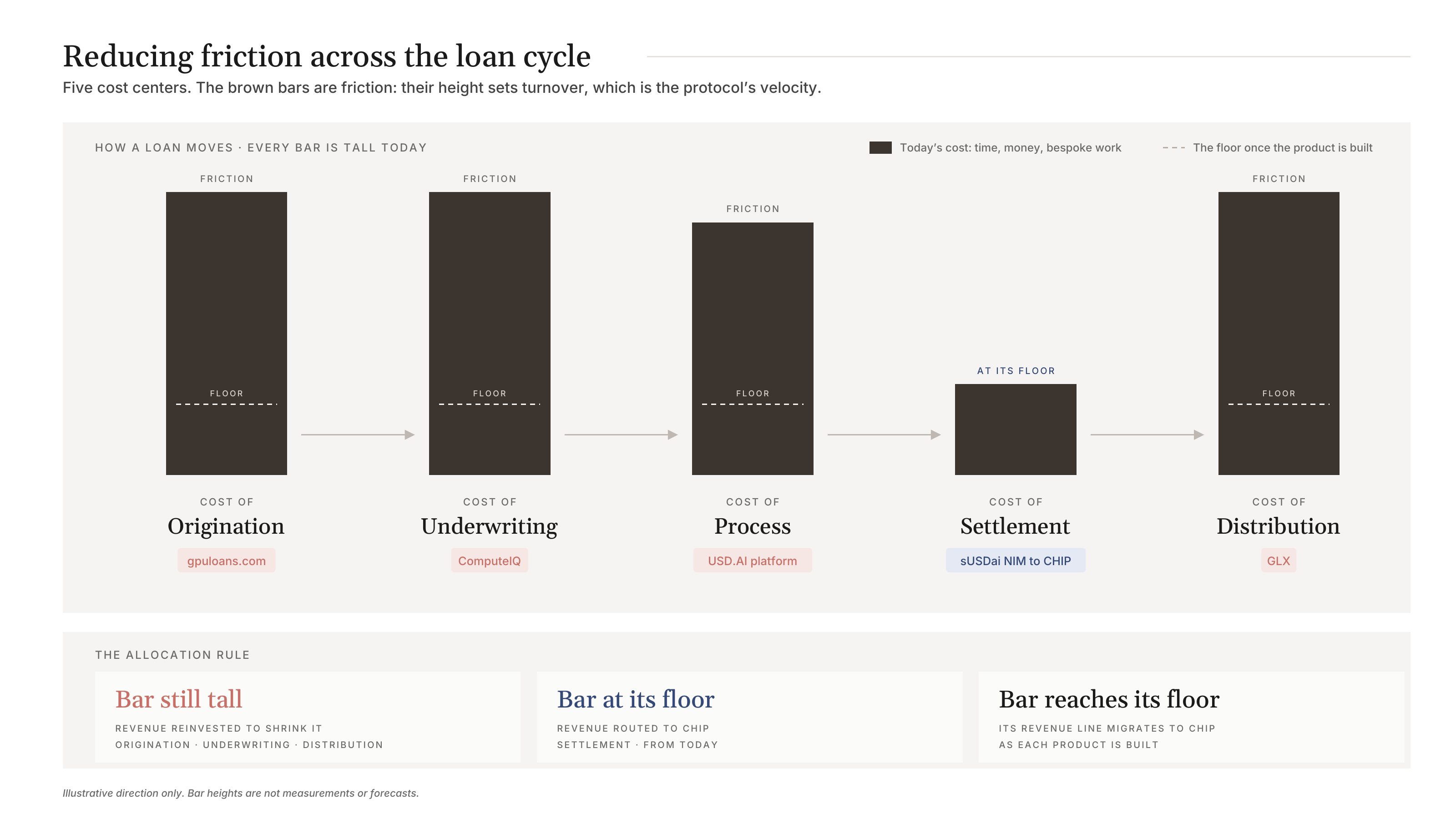
The allocation rule follows from the bars:
- Where a bar is at its floor, for example for the onchain contracts, they are deployed, audited and in use, the revenue earned on that stage goes to CHIP, programmatically.
- Where a bar is still tall, the revenue earned on that stage is reinvested to shrink it.
- When a bar reaches its floor, its revenue line migrates to CHIP.
The rule follows the maturity of each function, and so does decentralization. A stage can be governed onchain once it is standardized and observable. Settlement is. Origination, underwriting and distribution are still discretionary, bespoke work, so their revenue stays with the company doing that work, and reinvestment there is what makes them standard enough to govern later. Putting a function onchain does not make it efficient. The dependencies have to be reduced in practice.
Settlement is at its floor today, so sUSDai NIM goes to CHIP from today. Origination, underwriting and distribution are not, so origination fees and gain on sale are reinvested. The rest of this post walks through each line.
V1 Business Model: the Balance Sheet Lender
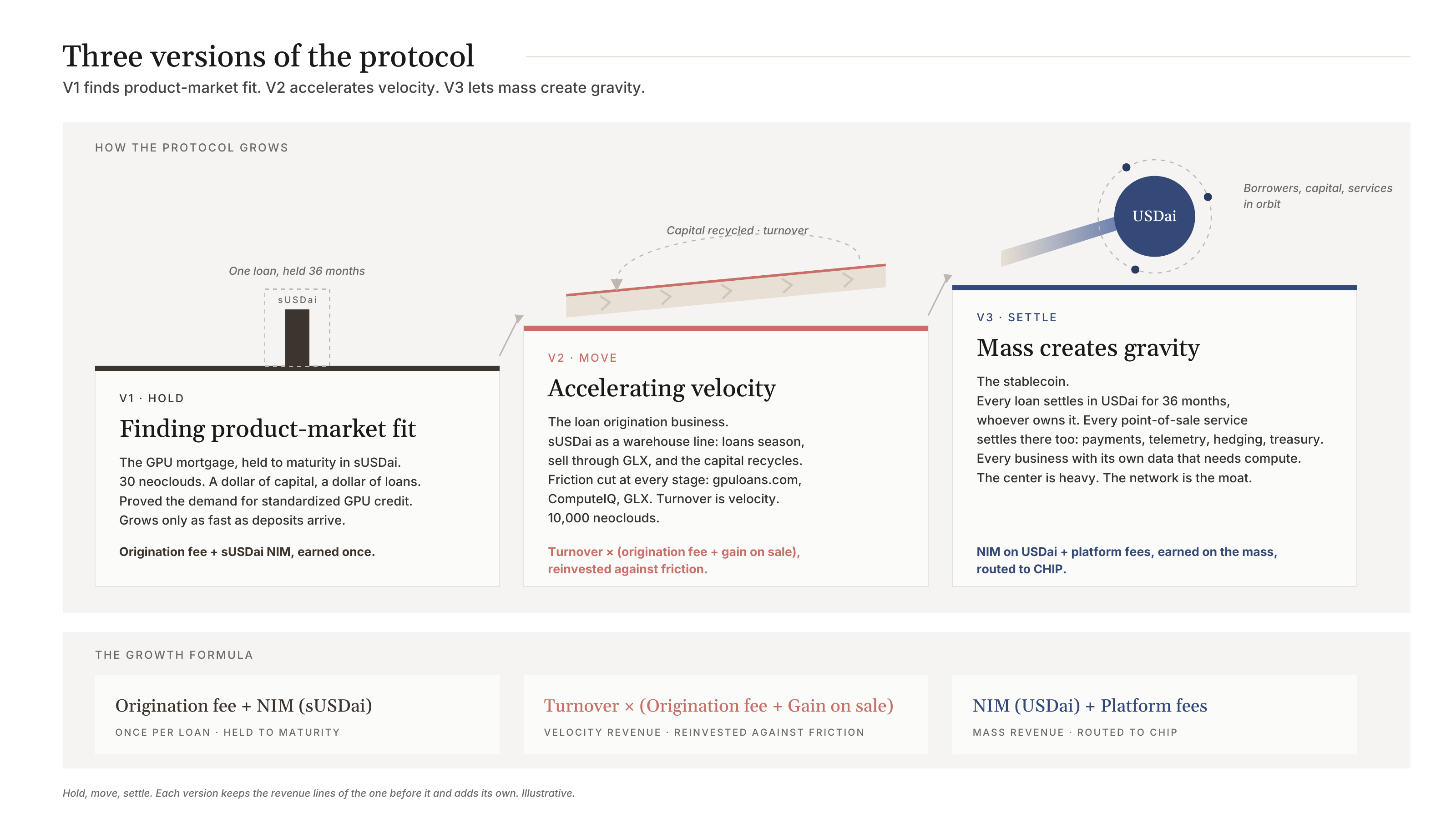
Until now, the protocol has raised capital into sUSDai, lent it to neoclouds and held each loan until it repaid. That earns revenue in two ways. An origination fee of about 2 to 3% on each loan. And NIM: the protocol keeps 10% of the yield sUSDai earns from GPU loan interest (after value insurance) and from PYUSD reserve yield. That is 10% of the yield earned, not ten percentage points of APY. The rest goes to sUSDai holders, and the net APY in the app is already shown after this share.
Per $1 billion of deposits, that produces roughly $20 million to $40 million of revenue a year. It is a fine business. It is also a linear one. A dollar of capital finances about a dollar of loans, so the protocol grows exactly as fast as new deposits arrive and no faster.
The brown bars below are the friction that decelerates the protocol. They show the time, money and cost each stage of a loan takes today. Every one of them is tall.
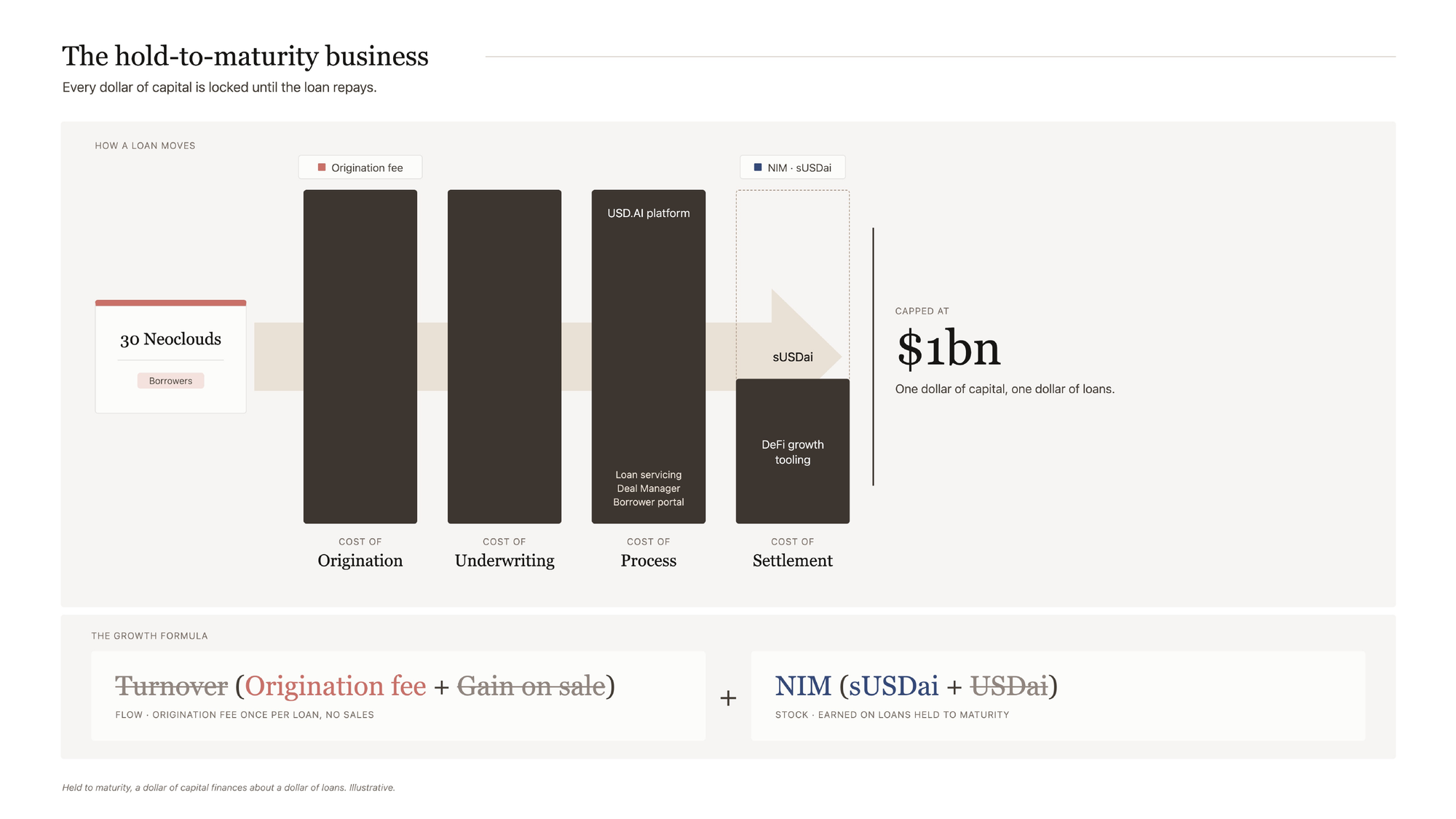
Two pieces of feedback have come up consistently. Onchain depositors, and curators in particular, want liquidity and short-duration exposure above all else. Offchain capital markets want the opposite: direct exposure to individual loans, little interest in tokenized products, and little need for liquidity. Holding to maturity satisfies neither.
It also cannot keep up with demand. As the first post in this series covered, the protocol has now seen about $25 billion of loan requests from a couple hundred borrowers, and the GPU financing opportunity runs to tens of billions of dollars of originations a year. A model that grows only with deposits cannot finance that.
V2 Business Model: the Volume and Origination Engine
The answer to both pieces of feedback is to stop holding loans to maturity. sUSDai now works like a warehouse line. A new loan is held in sUSDai for several months while it builds a payment history. Then it is sold to a permanent capital source through GLX, and the capital is lent again. A loan with months of payments behind it carries less risk than a new one, so buyers may pay more than face value for it.
The first sale, the $98.1 million Duos Edge AI facility, closed at par. As GLX builds its track record and its buyer network, later sales are expected to price above par. GLX is onboarding private credit funds and regional banks today, with family offices, life insurers and other asset managers to follow. The product each buyer sees can be tailored to its appetite: whole loans today, with structured and ABS products as velocity allows.
This changes what the protocol is. It stops being a balance sheet and becomes a throughput business. The metric that matters is turnover: how many times a dollar of capital finances a loan in a year. Turnover is the protocol’s velocity. Each turn earns a new origination fee and a new gain on sale. If $1 billion produces about $30 million at one turn, five turns a year multiply it. Five turns of $1 billion finance $5 billion of originations in a year: annual volume, not a balance, and it assumes demand, successful sales and redeployment. Revenue depends on how fast capital moves, not on how much of it sits in sUSDai.
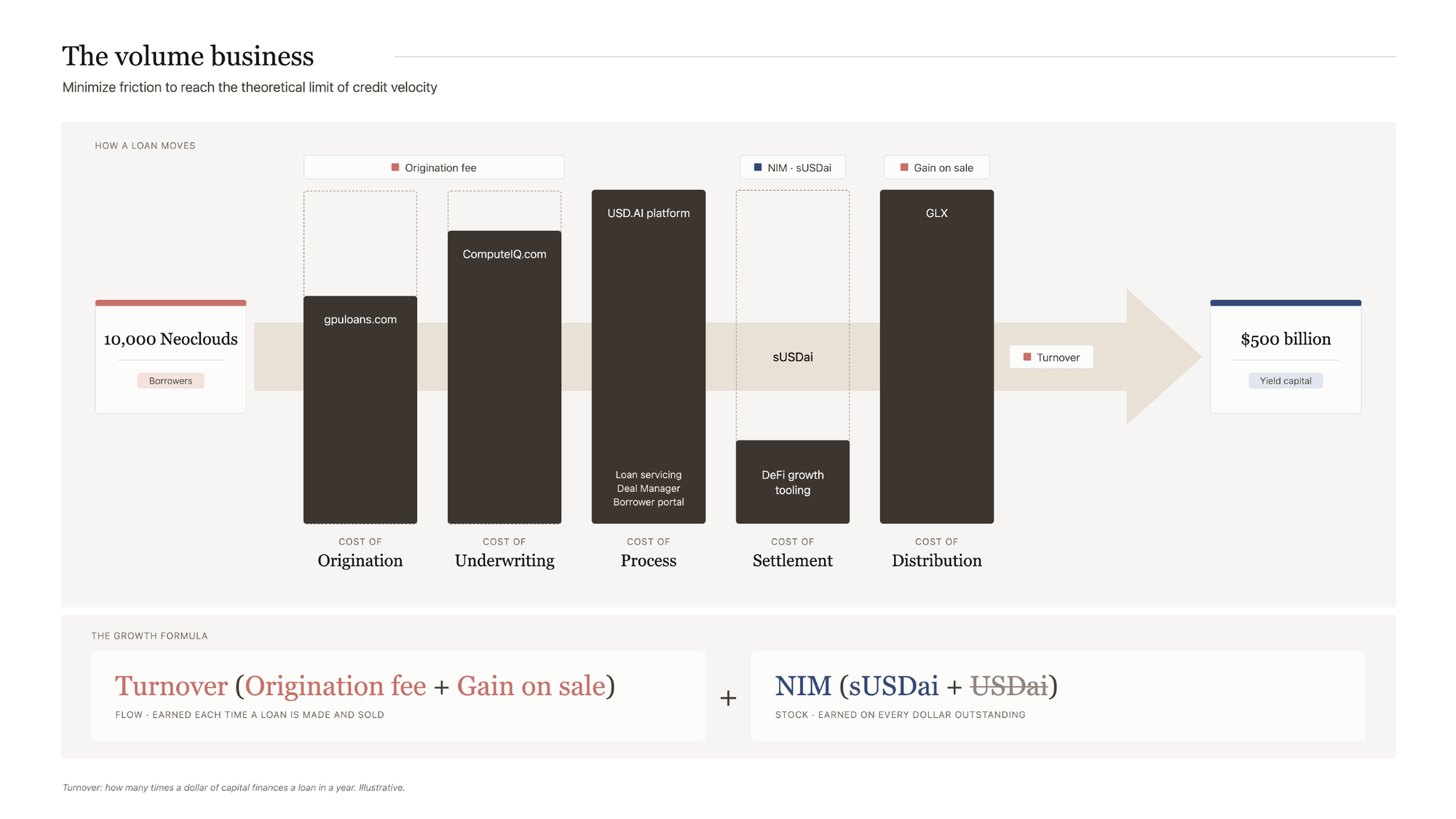
The growth formula now has two parts. The charts label them flow and stock. In the physics of the network they are velocity and mass. Velocity revenue (the charts’ flow) is earned each time a loan is made and sold: turnover × (origination fee + gain on sale). Mass revenue (the charts’ stock) is earned on every dollar outstanding: NIM on sUSDai, and in time on USDai.
Five revenue lines sit inside that formula:
- Origination fee: about 2 to 3% of each loan, earned every time capital is lent. It is coming down over time and stays competitive on smaller deals.
- Gain on sale: the margin when a seasoned loan is sold through GLX. It comes from the gap between the loan’s rate and the lower rate a buyer accepts for a loan with a payment history. The video’s example is a loan made at about 13% sold to a buyer whose cost of capital is about 12%. How much of that gap becomes a sale premium depends on the loan’s remaining duration, its performance and market conditions; today the sale spread is about 1 to 2%. It should widen as ABS and rated products for insurers give GLX access to cheaper capital. The target is a spread as wide as 5 to 6% once ABS markets open.
- NIM (sUSDai): the protocol’s 10% share of sUSDai yield. Capped by sUSDai TVL.
- NIM (USDai): earned on loans and repayments that settle in USDai, whoever owns the loan. Switched off today.
- Platform services: payments, telemetry, hedging and other services bundled onto settlement.
Selling loans raises one concern the forum has already voiced. As loans leave sUSDai, it holds fewer yielding assets, so its yield can dip even as its liquidity improves. The Yield Reserve addresses this. Managed by CHIP Foundation, it tops sUSDai up toward the 7% CHIP Hurdle Rate whenever yield falls below it, and never above it. It is funded by the treasury first and by 40% of gain on sale over time. Support depends on the reserve’s resources: the hurdle rate is a target the reserve defends, not an unconditional guarantee, and the reserve is only as well funded as the sales that feed it. The hurdle rate itself is a parameter CHIP holders can change.
V2.1: Why Velocity Is the Objective
Turnover is a function of cost. How many times a dollar can turn in a year depends on how much time and money each loan takes to make. A typical private credit fund spends at least $3 million to $5 million, and about six months, to complete a single loan. On a billion-dollar facility that is a rounding error. On a $50 million loan it is impossible. If the goal is 10,000 loans, the fixed cost per loan is the bottleneck, not the supply of capital.
The market is forcing the issue as power constraints are turning 250-megawatt sites into 2- to 5-megawatt modular deployments The $50 billion financings backed by a Meta, Oracle or Nvidia offtake are drying up, and GPUs will have to stand on their own as collateral. They can only do that at smaller deal sizes. Small loans diversify. Diversified pools can be securitized. Securitization is where the cheapest capital lives. Diversification manages concentration; it does not remove credit risk. Every debt market that reached the trillions got there by standardizing its unit.
Private credit is artisanal: bespoke, negotiated, and staffed by expensive lawyers. The protocol’s approach is the opposite. One standard GPU mortgage, repeated, sold into broad capital markets and recycled, on the way to a $20 billion-a-year issuance platform.
That is why velocity revenue is reinvested rather than paid out. Each product USD.AI Inc. builds removes friction at one stage:
- gpuloans.com lowers the cost of origination. As the brand has grown, demand now arrives directly as inbound.
- Compute IQ lowers the cost and time of underwriting. Every loan adds to the data the next loan is assessed against, so each loan makes the next one cheaper.
- GLX lowers the cost of distribution and widens the sale spread with each new class of buyer.
The target is a cost per loan below $1 million and a time to loan of 7 days, down from about six months. The reinvestments compound. ComputeIQ raises turnover. GLX widens the spread. Both are factors in the velocity formula, so velocity revenue multiplies as friction comes down. A dollar of origination fee spent on ComputeIQ comes back as higher turnover on every loan that follows.
Reinvestment has to earn its place and the test is whether it improves the next cycle: lower cost per completed loan, shorter time to funding or sale, better information, or broader access to suitable capital. Speed only counts if credit quality holds. Cutting diligence to report a higher turnover would undermine the economics this design is built on. Progress will be reported in those terms, cost per loan, time to loan and sale spread, alongside the protocol’s allocations, so that neither a purchase announcement nor a reinvestment budget has to be taken on faith.
V.2.2 Where Each Revenue Line Goes
Applying the rule to each line. Changes to protocol allocations take effect by CHIP vote. USD.AI Inc.’s spending, and any discretionary purchases from its fees, are the company’s decisions.
Velocity revenue: reinvested against friction
- Origination fees scale with originations × turnover. They are earned offchain by USD.AI Inc. and pay for origination and underwriting. Any excess may fund CHIP purchases at USD.AI Inc.’s discretion, held by USD.AI Inc. These are not guaranteed.
- Gain on sale scales with loans sold × sale spread. 60% is reinvested in distribution: expanding GLX to lower-cost buyers and opening ABS markets. The other 40% goes onchain to the Yield Reserve, so that sale proceeds, rather than CHIP emissions, fund sUSDai’s yield floor as it grows.
Mass revenue: funds CHIP
- NIM (sUSDai) is earned on the stage that is already built. The sUSDai contracts are deployed, audited and used by tens of thousands of people, and the distribution around them is established. There is nothing left at this stage to reinvest in. So 100% of sUSDai NIM, net of CHIP Foundation costs, is proposed to go to programmatic CHIP purchases from today.
- NIM (USDai) is switched off today, so it flows to sUSDai holders. It grows with USDai credit outstanding rather than with sUSDai deposits, so it is uncapped. Once credit outstanding reaches scale (the charts use $20 billion as a marker, not an automatic trigger), CHIP holders flip the fee switch and route it to CHIP purchases. It is expected to take over as the main source at that point.
- Platform revenue is earned offchain on installed borrower relationships. Its treatment will come to the forum once those services are live.
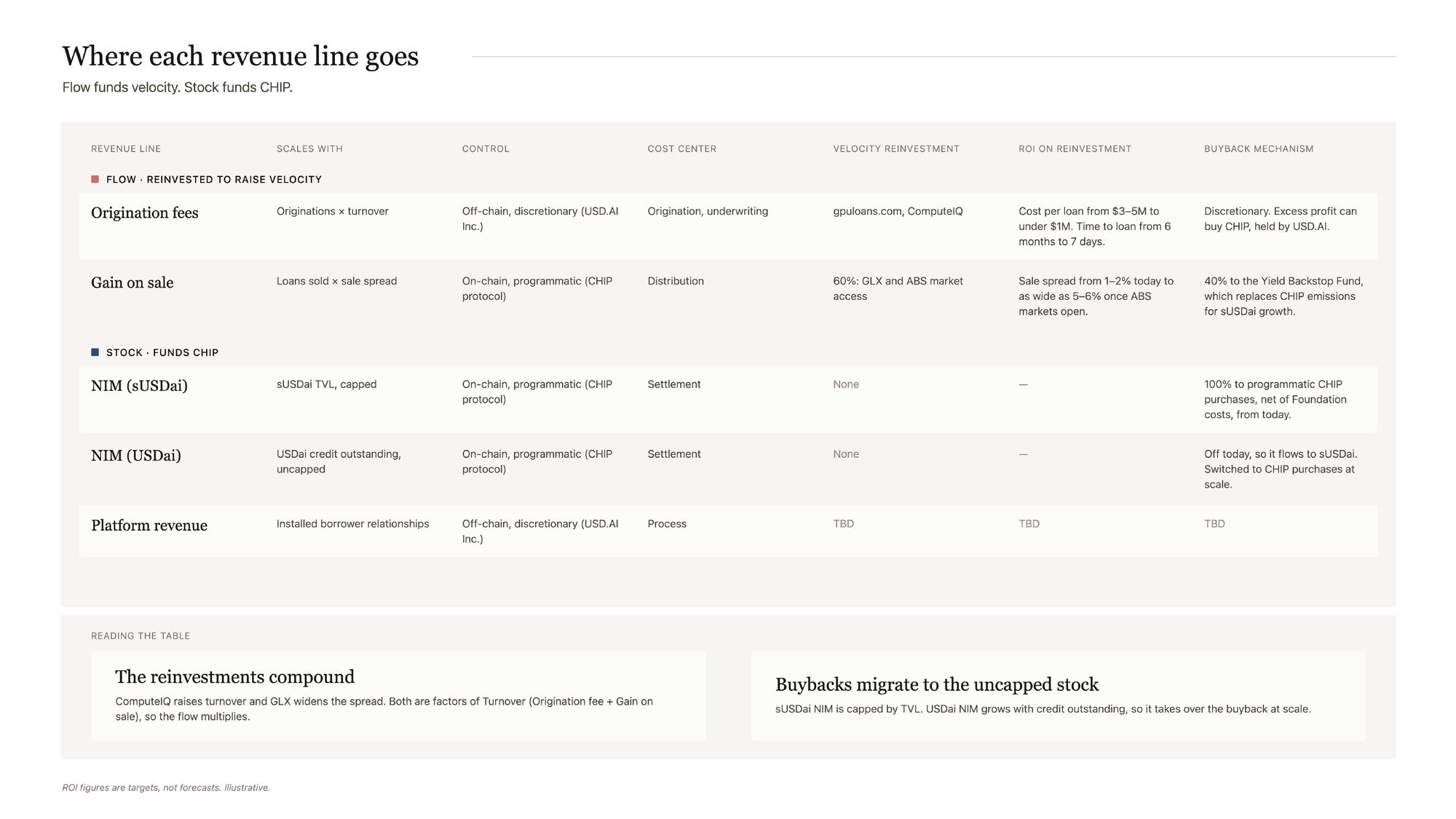
One thing to take from the table: CHIP purchases migrate to the uncapped mass. sUSDai NIM is capped by TVL. USDai NIM is not. So the purchase program grows with credit outstanding rather than with deposits.
V3 Business Model: the Stablecoin Mass as the Center of Gravity
A loan sold through GLX does not disappear. It is outstanding for 36 months, still paying, still settled in USDai whoever owns it. That is the GPU mortgage: payments, treasury and refinancing that settle in the protocol’s own dollar. Because the whole stack sits in one place, from origination to distribution, every loan stays in USDai from the day it is made to the day it repays.
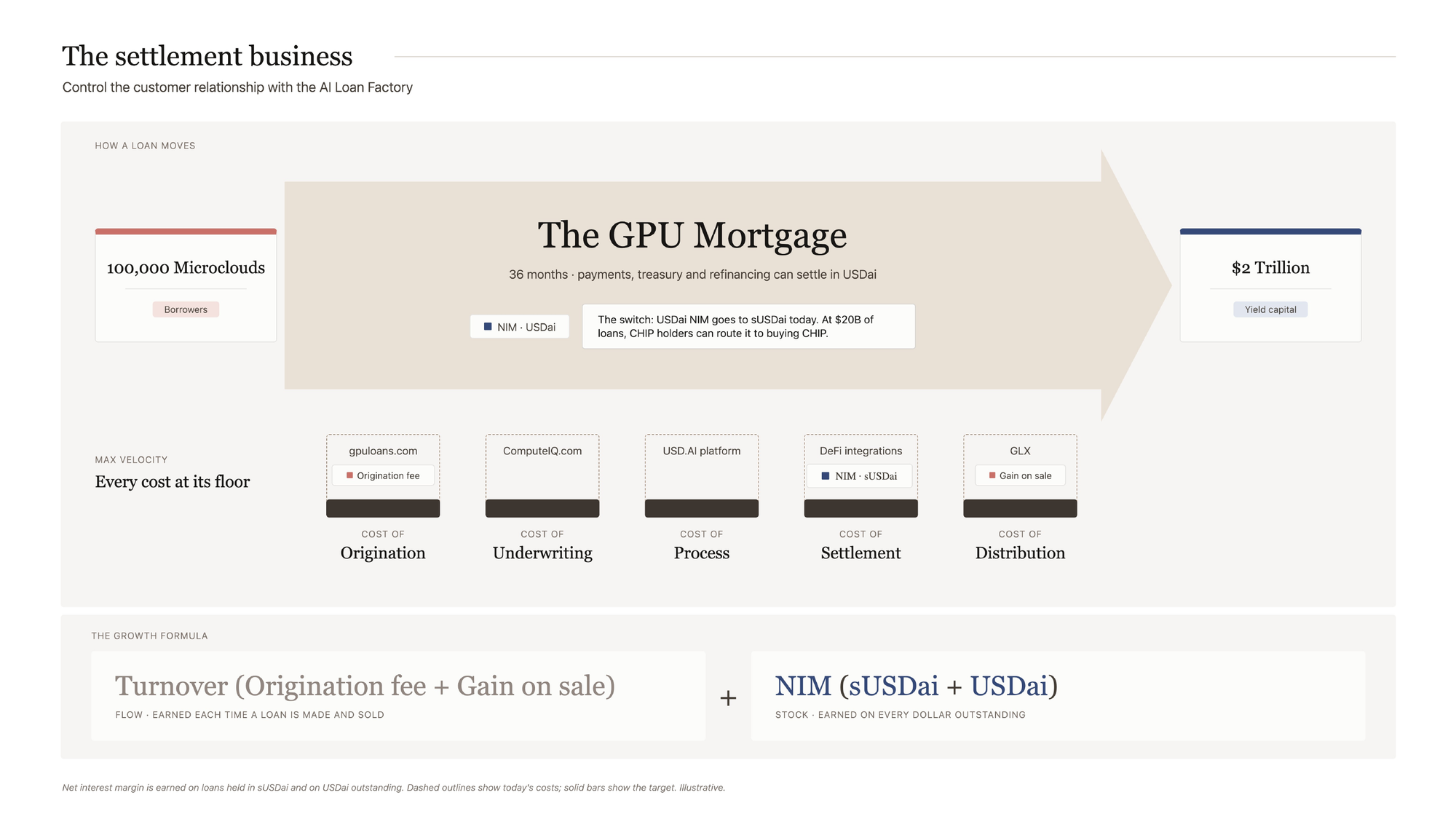
This is the mechanism of V3, and it is simpler than V1 or V2. V1 earned on the loans it held. V2 earns on loans as they move. V3 earns on the mass: every dollar of USDai outstanding, every day, whoever holds the loans. The marker the charts use is $20 billion of USDai outstanding. At that mass, CHIP holders flip a single lever, the next fee switch of the NIM on USDai (not sUSDai, that is already enabled) is routed to CHIP. Nothing new has to be built for that to happen. The contracts that settle the loans already exist and are already audited. The switch is a parameter. That is how the protocol reaches its full potential: not by adding a cost center, but by turning on revenue across the whole mass at once.
What takes the mass to $20 billion is adoption of USDai across compute, not the loan count alone. USDai is becoming the core balance sheet item for companies that want to own their compute. The mortgage puts it on the balance sheet for 36 months. The services around running that compute keep it there: payments, telemetry, hedging, treasury and refinancing, bundled onto settlement at close to zero incremental cost. It works the way an app store works on a phone that is already in your pocket. These platform fees are the fifth revenue line. In the long run they are the largest, because they are earned on the mass rather than once per loan.
The borrowers are changing too: not only neoclouds, but any company with its own data that needs compute to grow. Ten thousand of them is one of the largest borrower networks in the sector, and every one of them settles in the same dollar.
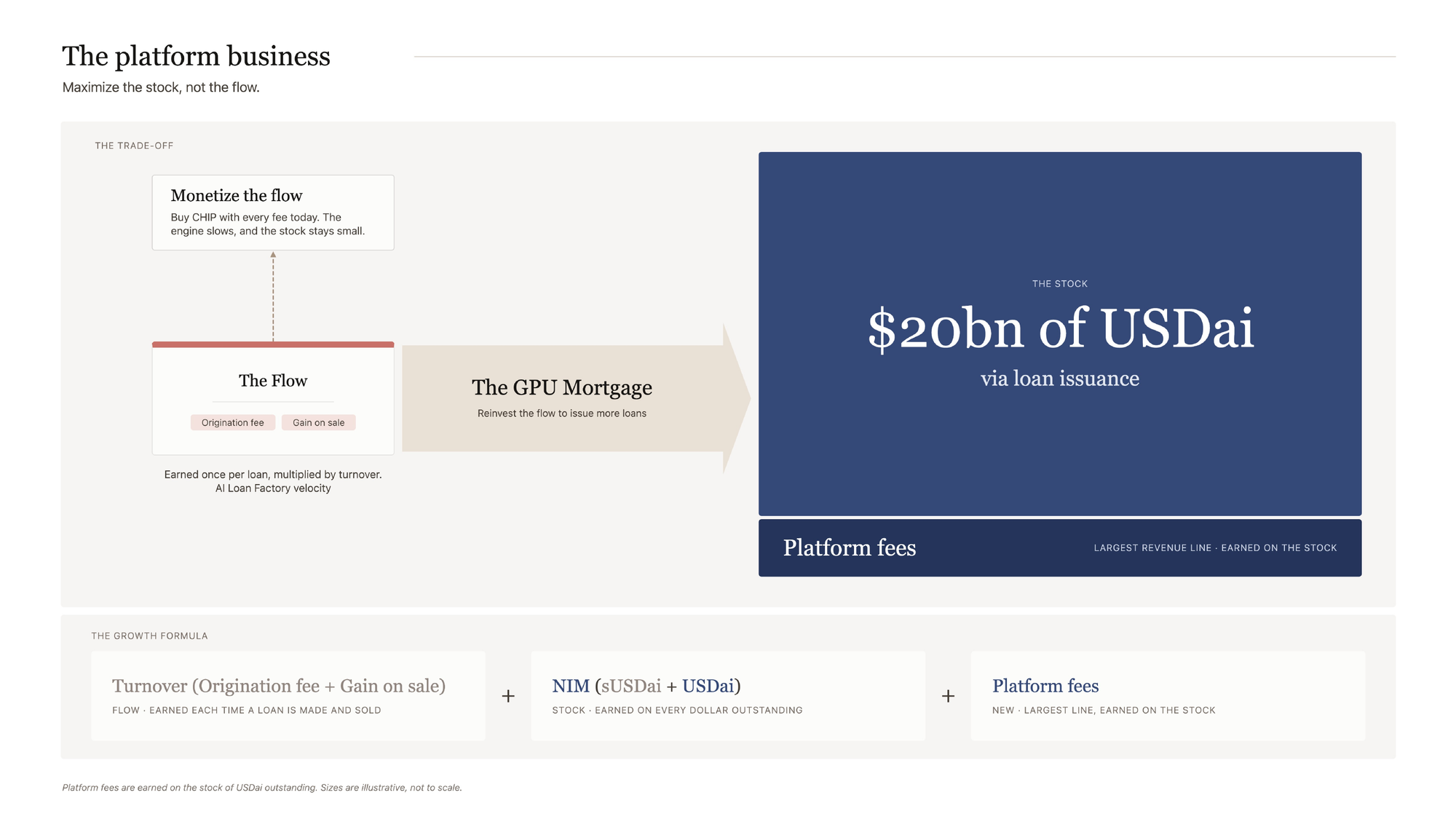
Velocity is the loan, earned once as it moves. Mass is the stablecoin, earned on every dollar outstanding, every day. Buying CHIP with every fee today would slow the engine and keep the mass small, and a small mass has no pull. Reinvesting velocity revenue builds mass, and mass is where the USDai fee switch does its work. That makes the mass the part of the ecosystem best suited to decentralization. It works on its own, it is governed onchain, and it is where revenue to CHIP comes from.
V3.1: the Platform, the Network Effects of USDai
The largest network-effect businesses in crypto are stablecoins. They win because they are liquidity as a service: once enough counterparties settle in the same dollar, every new participant has a reason to use it too. Mature capital markets work the same way. They organize around a center that everyone references, and the center holds because it is heavy.
The mass of the CHIP protocol is USDai and sUSDai outstanding, and it grows at the platform sales. A GPU mortgage is the first transaction. Once a borrower’s loan settles in USDai, the services around running that compute can settle in it too: payments, telemetry, hedging, treasury, refinancing. Each service bundled at the platform sales deepens the borrower’s use of USDai at close to zero incremental cost. Every loan adds mass. Every service adds mass again.
The borrower base makes this compound. The next 10,000 neoclouds are not only neoclouds. They are medium-sized AI companies: law firms, biotechs, research labs, every business with its own data that needs compute. When those businesses settle their AI services in USDai, the next vendor, the next capital source and the next service have a reason to accept it, hold it and build on it. That is gravity.
CHIP sets the terms of that mass: collateral, rate tiers, fees and the routing of mass revenue. The heavier the center, the more reason the largest actors have to align with the terms CHIP sets, and the larger the mass revenue, NIM on USDai and platform fees, that CHIP holders route. The gravity is the point.
It is also the reason velocity revenue is reinvested. Velocity is what adds mass: more loans, more borrowers at the platform sales, more services settling in USDai. Spending it on CHIP purchases before the mass is there keeps the center light, and a light center has no pull.
CHIP Hardening: from Inflation to Net Deflation
Today, CHIP incentives are funded by issuance and paid through the Allo Game, the protocol’s seasonal points program. Emissions have fallen each season, from 3% of supply in Season 1 to 2.25% in Season 2. The proposals above change where that CHIP comes from. Instead of minting it, the protocol purchases it with revenue: sUSDai NIM from today, NIM on USDai once the fee switch is flipped, and platform fees after that. As the mass grows, purchases should rise until they exceed new issuance. At that point emissions are no longer needed and rewards move from seasons to a monthly schedule funded by revenue. USD.AI Inc is another proxy of an entity purchasing CHIP over time, as a way to have institutional participants who would otherwise be unable to purchase CHIP, to get a proxied exposure through an equity vehicle (known as commit & compound).
Net deflation is the hardening objective, not an automatic result of purchases. It depends on what happens to the CHIP the protocol buys. Tokens held by CHIP Foundation or retired reduce circulating supply; tokens redistributed as rewards do not. The final mechanism will make that split explicit. And “programmatic” describes how an approved allocation is executed, not a fixed purchase amount or an outcome.
Every step in this design is a parameter that CHIP holders set, and can change or pause: the underwriting parameters for new sUSDai financings (separate proposal), the routing of sUSDai NIM, the 60/40 split of gain on sale and the hurdle rate the Yield Reserve defends, the fee switch on USDai NIM, and the treatment of platform revenue when it arrives. The numbers in this post are targets and illustrations, not projections. Purchases by USD.AI Inc. from its own fees are at its discretion and are not guaranteed. What is fixed is the rule: revenue from a finished stage is directed by CHIP holders to CHIP, and revenue from an unfinished stage is reinvested to finish it.
What’s Next
These proposals will be brought to the CHIP governance forum, beginning with the routing of sUSDai NIM.
The path runs in three versions. V1 found product-market fit. V2 is building the moat: faster turnover, lower cost per loan, and a stack of information that makes each loan faster than the last. V3 is the mass: $20 billion of USDai outstanding, settling the loans, the payments and the treasury of every company that owns its compute, with a fee switch that turns the whole of it into revenue for CHIP at once.
The protocol does not need to be the largest holder of compute loans. It needs to be the system the most compute loans move through, and the dollar they settle in. That is the North Star, and every loan adds mass to it. The allocation proposed here is not the one that monetizes the most today. It is the one that gets to the mass fastest, with CHIP tied to the engine from the first day.
Disclaimer
This communication is not directed at residents of the United States, United Kingdom, or other jurisdictions where the distribution of such content may be restricted. USDAI is a non-custodial decentralized protocol providing structured lending infrastructure. USDAI does not custody assets, execute trades, or act as a broker, dealer, or investment adviser. Nothing herein constitutes investment advice, a recommendation, or an offer or solicitation to purchase any digital asset. All interactions are executed directly between users and on-chain smart contracts, subject to applicable protocol terms. Participation involves risk including potential loss of funds. All figures, amounts, rates, yields, fees, valuations, and growth scenarios presented are hypothetical and for illustrative purposes only. They do not represent actual results, forecasts, commitments, or guarantees of future performance. Actual outcomes may differ materially, and no assurance is given that any illustrated scenario will occur. Do your own research.