













Upgrading sUSDai with Barkr Residual Value Protection
Update (October 2026): This article refers to CALIBER, an earlier USD.AI framework in which an NFT served as the document of title for GPU collateral. CALIBER is no longer part of USD.AI's loan structure. Legal rights to the collateral now come from a bankruptcy-remote SPV and a first-priority lien under the loan documents, and Loan NFTs serve as onchain records. Insurance remains a standard requirement on every USD.AI loan. See docs.usd.ai/usdai/how-it-works for the current model.
Update (October 2026): This post has been revised to reflect the current terms of the Barkr residual value warranty. Barker has since rebranded as Barkr.
Today we are announcing two changes to USD.AI’s risk architecture: a new partnership with Barkr for institutional-grade collateral protection, and the removal of FiLo tranche requirements for new loans.
What FiLo Was and Why We Moved Past It
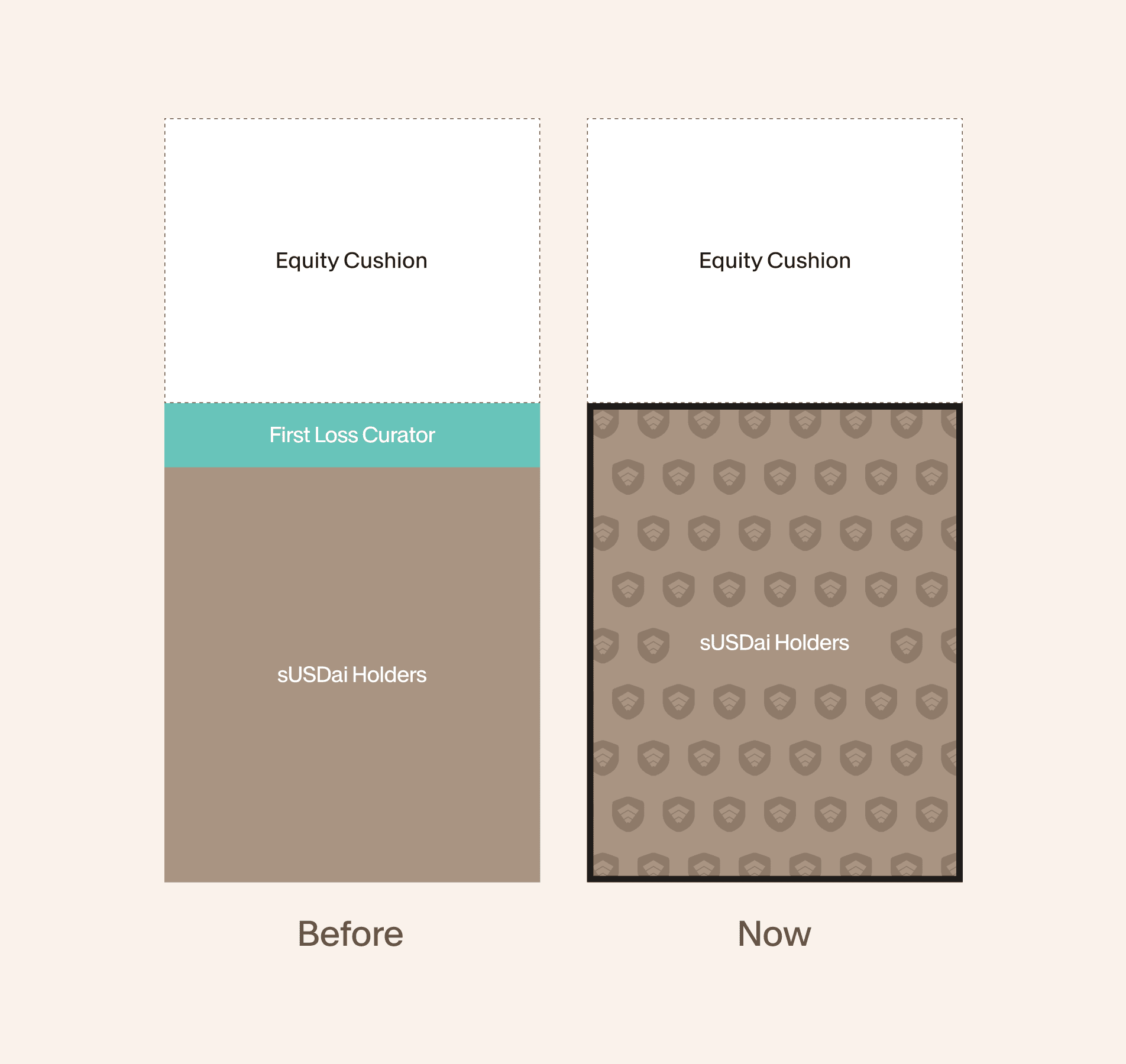
FiLo - “First Loss” - was USD.AI’s mechanism for protecting sUSDai holders against defaults on GPU-backed loans. A junior tranche absorbed losses before they reached stakers. It worked as designed, but it introduced friction for borrowers and locked up capital that could otherwise flow as income to sUSDai holders.
We built FiLo as a first-generation solution with the explicit intention of replacing it when a more capital-efficient structure became available. That structure now exists.
How the Barkr Warranty Works
Barkr is an institutional valuation and risk transfer platform that has facilitated approximately $10 billion in collateral valuations for bulge-bracket banks and specialty lenders. Their domain-specific AI values loan collateral independently, completely separate from USD.AI’s own assessment, and warranties the accuracy of that valuation.
Barkr provides a residual value warranty on GPU collateral where a deal includes it. The warranty is required where the offtaker is not investment-grade or the compute is sold as on-demand rental.
If the servers are sold below an agreed floor, Barkr covers part of the shortfall, subject to the warranty’s conditions, including suspension during a market-wide shock. The warranty applies to a sale of the servers; it does not apply to a sale of the SPV as a whole. That obligation is not sitting on a startup’s balance sheet. The warranty is backed by an A-rated institutional reinsurer with a long track record and hundreds of billions in insured value.
This does not eliminate risk entirely. Barkr’s AI model carries its own assumptions, and extreme market dislocations in GPU pricing could stress the system beyond predicted ranges. The structure is designed to mitigate default and liquidation risk, not to guarantee that no loss is possible under any scenario.
What Changes for sUSDai Holders
With FiLo tranches removed from new loans, income that previously flowed to junior tranche holders is now directed to sUSDai.
The shift from a capital-reserve model (FiLo) to a warranty-backed model (Barkr + institutional reinsurance) changes the risk profile in a specific way: instead of relying on a junior capital buffer that can be depleted, part of the residual value risk on deals that include the warranty is transferred to Barkr and its reinsurer. A leading reinsurer does not back collateral programs casually, their participation reflects an independent assessment that USD.AI’s underwriting standards meet institutional thresholds.
Implementation
New GPU loans issued through USD.AI carry Barkr’s residual value warranty where a deal includes it, starting immediately. The first loan under this structure is being issued to Qumulus AI this week.
Existing FiLo tranche positions remain in place and are unaffected. Nothing changes for current FiLo holders.
This partnership is designed to support the next phase of scaling, the kind of scale where a 140-year-old reinsurer is comfortable attaching their name to our CALIBER collateral framework.