
















How sUSDai Yield Works and the CHIP Hurdle Rate
Summary
The CHIP Foundation donated 127,927.66 USDai into sUSDai under the CHIP Hurdle Rate (CHR). That brought the yield for someone who deposited on Oct 15, when CHR launched, to a 7% APY through Nov 1, measured just before redemptions were processed. Holders who stayed through the redemption earned about 8.04% over the same period.
How long you held matters. Redemptions are paid every 30 days, and the redemption price counts loan interest only once borrowers pay it. If you held through a full 30-day period, you captured that period’s payments and likely earned more than 7%. If you redeemed sooner, some of the interest you earned hadn’t been paid yet, such as payments that landed on Nov 6, after this redemption. That interest stayed in sUSDai and lifted the share price for holders who stayed, which is where the extra above 7% comes from.
This post explains why sUSDai yield arrives in steps, how its two share prices keep that fair to everyone, how CHR works from here, and what is changing to make the timing easier to follow.
How sUSDai Yield Works: Asynchronous Deposits via ERC-7540
sUSDai is built on the ERC-7540 asynchronous standard, so deposits and redemptions do not settle at the same price or time. It has two share prices, which count interest at different moments.
- Deposit share price counts loan and escrow interest as it accrues, every second. New deposits mint at this price.
- Redemption share price counts loan and escrow interest only once it is paid. Redemptions are paid at this price.
Both include base yield on the PYUSD backing as it accrues. Both are net of the 10% protocol fee.
Why two prices. sUSDai is backed by loans to GPU operators. They pay interest monthly, not every block. With one price, someone could deposit just before a large payment lands, redeem right after, and take a month of interest earned by others. The two prices and the 30-day redemption cycle stop that and protect long-term holders.
The trade-off. Between payment dates, the redemption price trails the deposit price by up to a month of interest. Hold through a full cycle and you capture it. Redeem earlier, and interest that built up during your stay but wasn’t yet paid stays in sUSDai. As borrowers pay it, it lifts the share price for holders who stay.
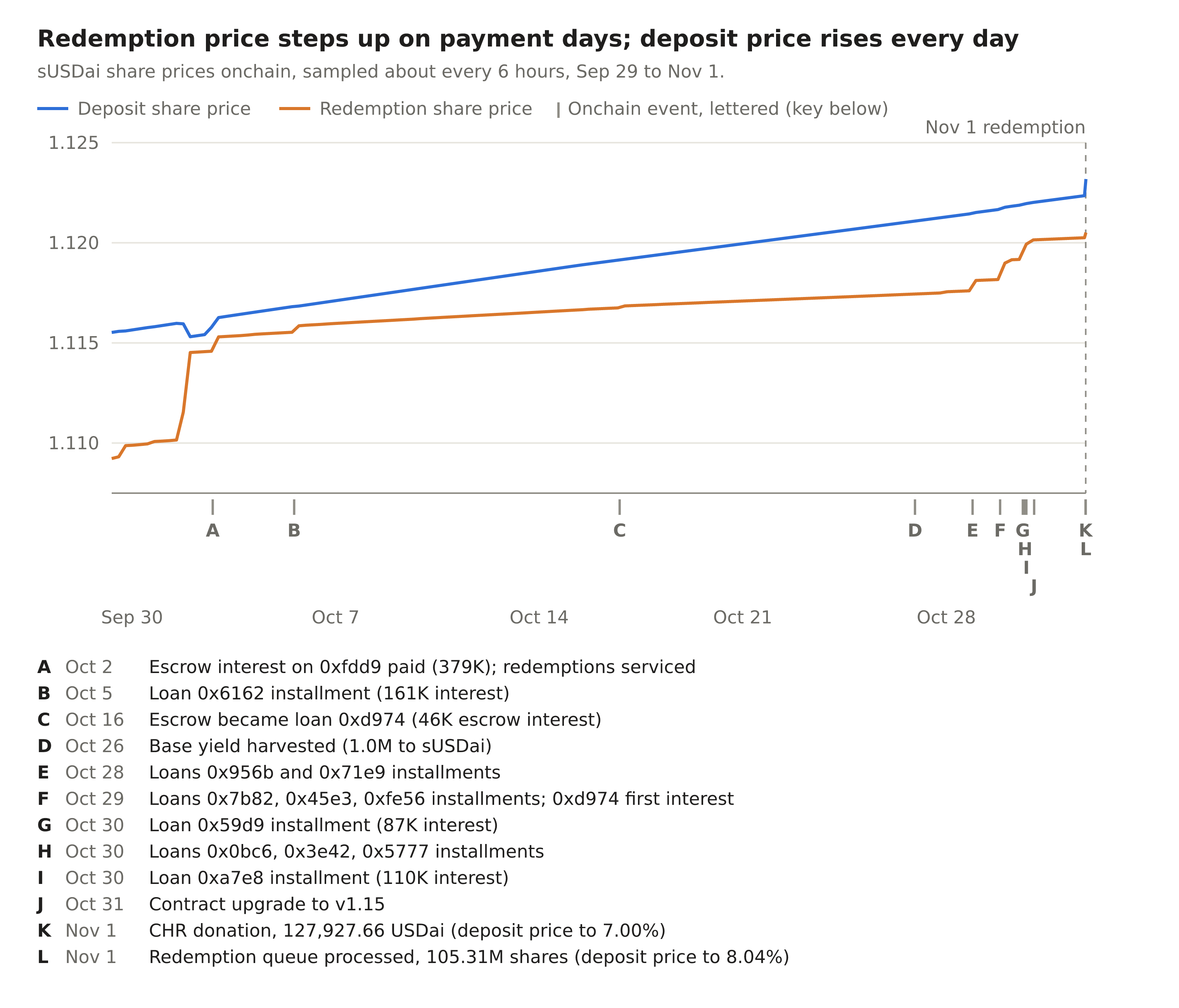
The deposit price climbs steadily as interest accrues. The redemption price moves in steps on payment days, then catches up.
Example: This Period
From Oct 15 to Nov 1, the deposit share price rose at a 6.53% annualized rate before any donation. The donation lifted that to 7.00%. The Nov 1 redemption then added about another point for holders who stayed, taking them to about 8.04%.
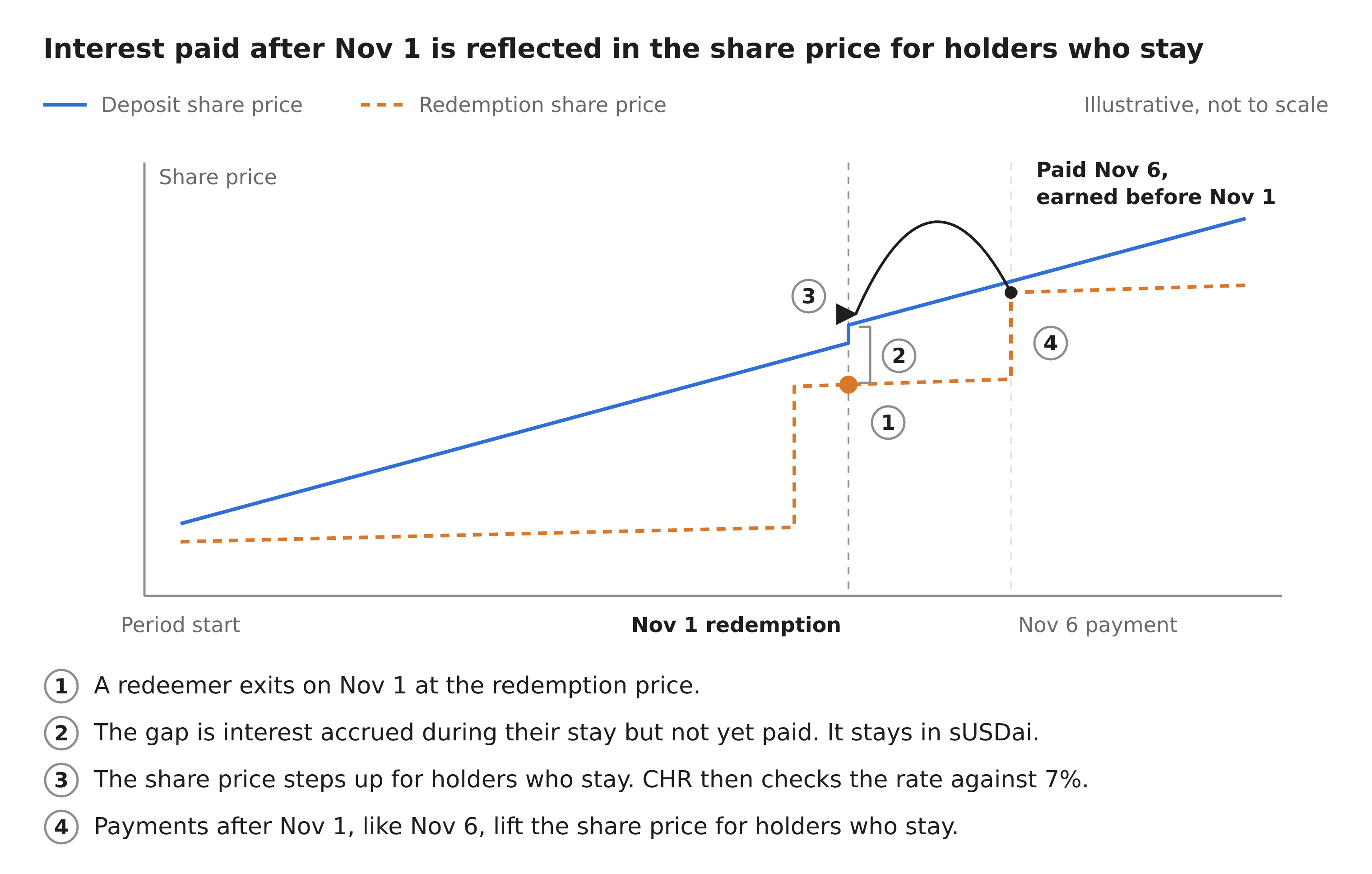
Redeemers were paid at the Nov 1 redemption price (the dashed line). Interest that borrowers paid after that date, including interest earned before Nov 1, lifts the share price only for holders who stayed.
| Measure | What it measures | APY |
|---|---|---|
| Site APY (app.usd.ai) | Annual run rate: current net yield on all loans, escrow and the PYUSD backing, annualized. It isn’t tied to a redemption period, so it won’t match the period figures below. | ~6.2% |
| This period, before any donation | Actual change in the deposit share price from Oct 15 to Nov 1, 19:00 UTC (17.79 days), annualized. Includes one-off bumps such as escrow conversions, the base-yield harvest and late-October installments. | 6.53% |
| CHR donation (127,927.66 USDai) | Closes the gap to the 7% hurdle for this period | +0.47 pts, to 7.00% |
| Yield left by redeemers | Interest earned before Nov 1 but paid after it. Holders of the 105.31M redeemed shares left it behind, lifting the share price for holders who stayed. | +1.04 pts |
| This period, after the redemption event | Deposit share price change for holders who stay, Oct 15 to Nov 1 | 8.04% |
The site APY shows what sUSDai earns at any moment, annualized. The period figures show what the share price actually did between Oct 15 and Nov 1. Both sit below 7% partly because base yield fell in mid-October, when large outflows on Oct 15 shrank the PYUSD backing that earns it.
How the donation was sized. The donation targeted the deposit share price for someone who deposited on Oct 15, measured at Nov 1, 19:00 UTC, just before the redemption queue was processed.
- Start price on Oct 15: 1.118800.
- Target price at a 7% simple annualized rate over 17.79 days: 1.118800 × (1 + 0.07 × 17.79 / 365) = 1.122617.
- Projected price without a donation: 1.122360, a 6.53% annualized rate.
- Shortfall per share: 1.122617 − 1.122360 ≈ 0.000257.
- Donation: shortfall × 497.84M shares = 127,927.66 USDai, sent onchain at 18:54 UTC.
Figures are rounded to six decimals. The exact donation was 127,927.658346 USDai.
This sizing applied to this month. It was set before counting the interest redeemers left behind, which alone would have taken holders who stayed above 7%. The ongoing CHR mechanism will be finalized in an upcoming governance proposal, open to community input.
How CHR Works from Here
CHR is ongoing. Each redemption period, it supports a 7% annualized rate on the deposit share price, subject to available capital. The proposed process, subject to that governance proposal:
- Measure. Take the deposit share price, which is already net of fees, at the start of the period and again after the redemption queue is processed.
- Compare and donate. If the annualized change is below 7%, the CHIP Foundation donates the difference into sUSDai from the Yield Reserve, and it’s reflected in the share price.
- Publish. Each donation is sent onchain as one exact amount.
Periods that earn more than 7% get no donation, and holders keep the full yield. The 7% applies to the deposit share price over a whole period, so a holder’s own yield also depends on when they enter and exit.
What We Are Changing
Loan payments follow invoices, wires and borrower operations, so they will always arrive in steps. These changes make those steps more predictable.
- Higher escrow rates. Capital in escrow earns interest while it waits to fund loans, and that interest is part of sUSDai’s yield. Escrow earns 6–8% today, and new escrows are set to earn 10% or more.
- Borrower payments on the 1st. Borrower payments are moving to the 1st of the month, so they arrive together. This period, some landed as late as Nov 6.
- Redemptions after payments settle. We’re targeting the 2nd of each month for redemption processing, after the month’s payments land. The contract runs on 30-day periods today, so calendar dates need a contract upgrade first.
- Smoother redemptions. We’re working with DeFi partners on further improvements to redemptions, planned for the coming months and open to all holders.
Closing
sUSDai yield comes from GPU loans with monthly payment cycles. The two share prices keep that fair between holders who stay and holders who leave. CHR supports a 7% rate each period, and the changes above make the timing easier to plan around.
Disclaimer
This post is for information only. It is not investment advice, a recommendation, or an offer or solicitation to buy or sell any digital asset. sUSDai yield is not guaranteed and can be lower, zero or negative. Past yields, including the figures in this post, don’t predict future results. The CHIP Hurdle Rate is not a guaranteed minimum and depends on available capital. Redemptions are processed in 30-day cycles from available cash, and payment can take longer when cash is short. The planned changes described above are targets and may change. sUSDai is not a bank deposit, savings account or bank product. Holding it involves risks including borrower default, collateral losses, enforcement delays, and smart contract and operational failures, and holders can lose principal. This communication is not directed at residents of the United States, the United Kingdom, or other jurisdictions where its distribution may be restricted.