
















Rent Is Due: Why 10,000 Companies Will Own Their Compute


The next big group of GPU operators won't rent compute. They'll use it.
The first wave of neoclouds came out of Bitcoin mining, because miners had the one thing AI needed most and couldn't get quickly: power. The second wave was general-purpose inference sellers, companies built from day one to rent out GPU capacity, helped along by modular data centers that made power faster to bring online.
Between them, they lowered the bar for running a cluster far enough that a third wave is evident. AI-native software companies first, and increasingly law firms, biotech companies, materials science labs, venture capital funds, trading firms and AI safety teams. These own-use companies whose product depends on compute are now deciding to own it.
The shift shows up in four places at once: in rental prices, in enterprise IT plans, in venture portfolios and in lenders' pipelines.
Renting Is Getting More Expensive
The clearest catalyst we’ve seen is that GPU rental prices have skyrocketed in the past year, as demand grows across all industries.
On 1 October, Nebius raised on-demand prices for its main Nvidia GPUs: H100 from $3.85 to $4.50 an hour (+17%), and H200 from $4.50 to $5.40 (+20%). CoreWeave raised GPU prices 25% in July, then another 10% about two months later. Compounded, that is roughly 37.5% since July. CoreWeave also says its near-term capacity is effectively sold out, including prior-generation chips.
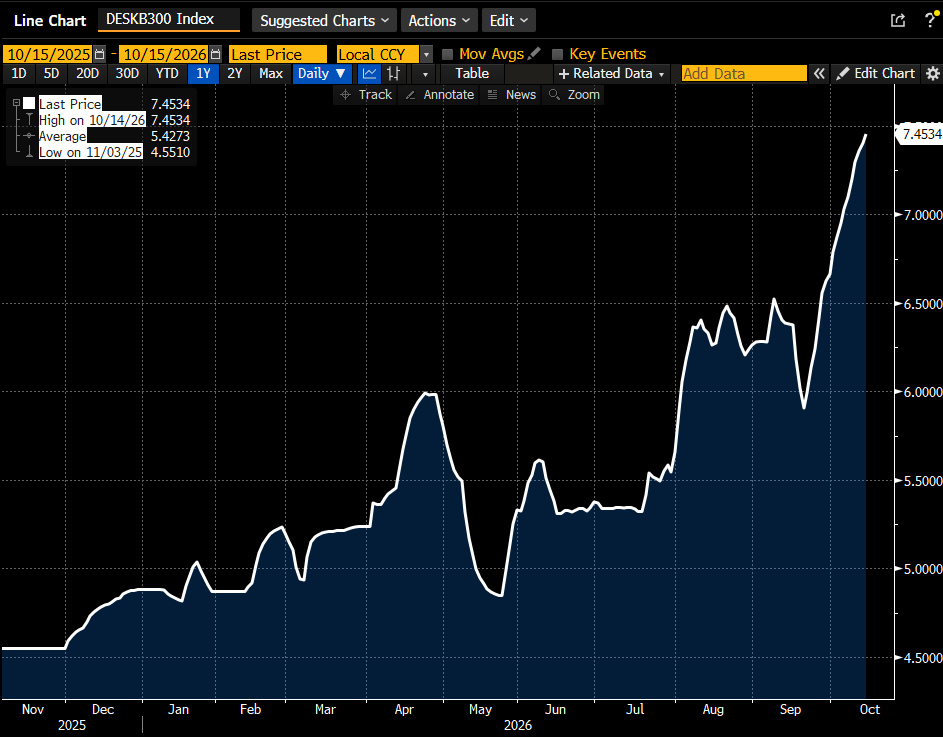
Even in the on-demand markets average prices are tracking similar increases. The SemiAnalysis H100 one-year contract index rose 38%, from $1.70 to $2.35 per GPU-hour, between October 2025 and March 2026.
For an AI-native company, compute is often the biggest line on the P&L. When rental payments surge by a third in a single quarter, margins tighten rapidly. Without a long-term contract, companies naturally begin exploring ownership. A fixed monthly payment, an asset at the end, and no landlord repricing the lease. A company running open-weight models on its own hardware also keeps its data in-house. For a law firm or a biotech lab, compliance and data safety are critical factors that cannot be ignored.
Enterprises Are Bringing Inference In-house
AI compute is following a different path from general-purpose cloud computing. Enterprises are moving inference off the public cloud.
In Broadcom’s Private Cloud Outlook 2026, a survey of 1,800 senior IT leaders, the share running or planning to run production inference on public cloud fell from 56% to 41% in a year, while 56% now run or plan to run it on private cloud.
A Cloudera survey of 1,500 enterprise architects, fielded in June 2026, found 66% had moved some AI workloads back to private cloud or on-premises in the past year.
Another example, Comma.ai’s CTO estimates the company has spent about $5 million on its own data center, most of it 600 GPUs, against $25 million or more for the same work in the cloud.
Each of these points to the same thing. As companies run AI in production every day, more of them are deciding to own their GPUs, and the amount of hardware sitting on enterprise balance sheets is growing quickly.
VCs Are Becoming Compute Landlords
It’s not just companies making the switch, even their investors are jumping feet first into owning compute. a16z, which built a 20,000-GPU cluster for its startups two years ago, is reportedly in talks to expand it through Switch and Volta, two infrastructure companies it backs. General Catalyst is reportedly building its own data center. Coatue, Crucible Capital and Kearny Jackson are pooling chips too. And Nat Friedman and Daniel Gross's portfolio cluster grew into Andromeda, now a $1.5 billion compute marketplace.
In addition to writing checks, they're giving out compute to fund the next wave of AI enabled startups. It’s a natural value chain to own and use to cut costs at portcos.
Providing compute makes clear strategic sense: equity is the most expensive capital to raise, yet compute is both essential and the single largest expense for these AI-driven companies. VCs understand that startups need access, but they also want to prevent founders from plowing their entire funding rounds into rapidly depreciating hardware or paying inflated rental rates where they hold little bargaining power. Pooling compute to subsidize their portfolio companies' biggest expense is a natural solution.
By owning compute and providing it ad hoc, VCs can also smooth out utilization. A single startup's demand is inherently spiky—heavy during training runs and light afterward. Cast AI measured average GPU utilization in standalone Kubernetes clusters at 5%. In a shortage, terms get worse: a16z has said capacity once sold on six-month contracts can require three-year commitments. A cluster pooled across a portfolio, with idle capacity resold, fills those gaps. One startup's cluster can't.
Lenders Are Seeing New Borrowers
We’re just on the very edge of this new customer type emerging. We know this at USD.AI as we see more GPU financing deals than probably anyone else on earth. Through 14 October this year, we’ve reviewed nearly 700 GPU financing deals representing about $25 billion of loan demand. Of the 427 qualified borrowers we’ve tracked since mid-2025, neoclouds still make up the majority, but own-use buyers are the fastest-growing group: from 2 new borrowers in Q4 2025 to 4, then 10, then 21 in Q3 2026, roughly doubling each quarter. In Q3 they grew 110% while new neocloud borrowers grew 65%, and they now account for about one in seven new qualified borrowers, outnumbering the bitcoin miners who started the neocloud market four to one.
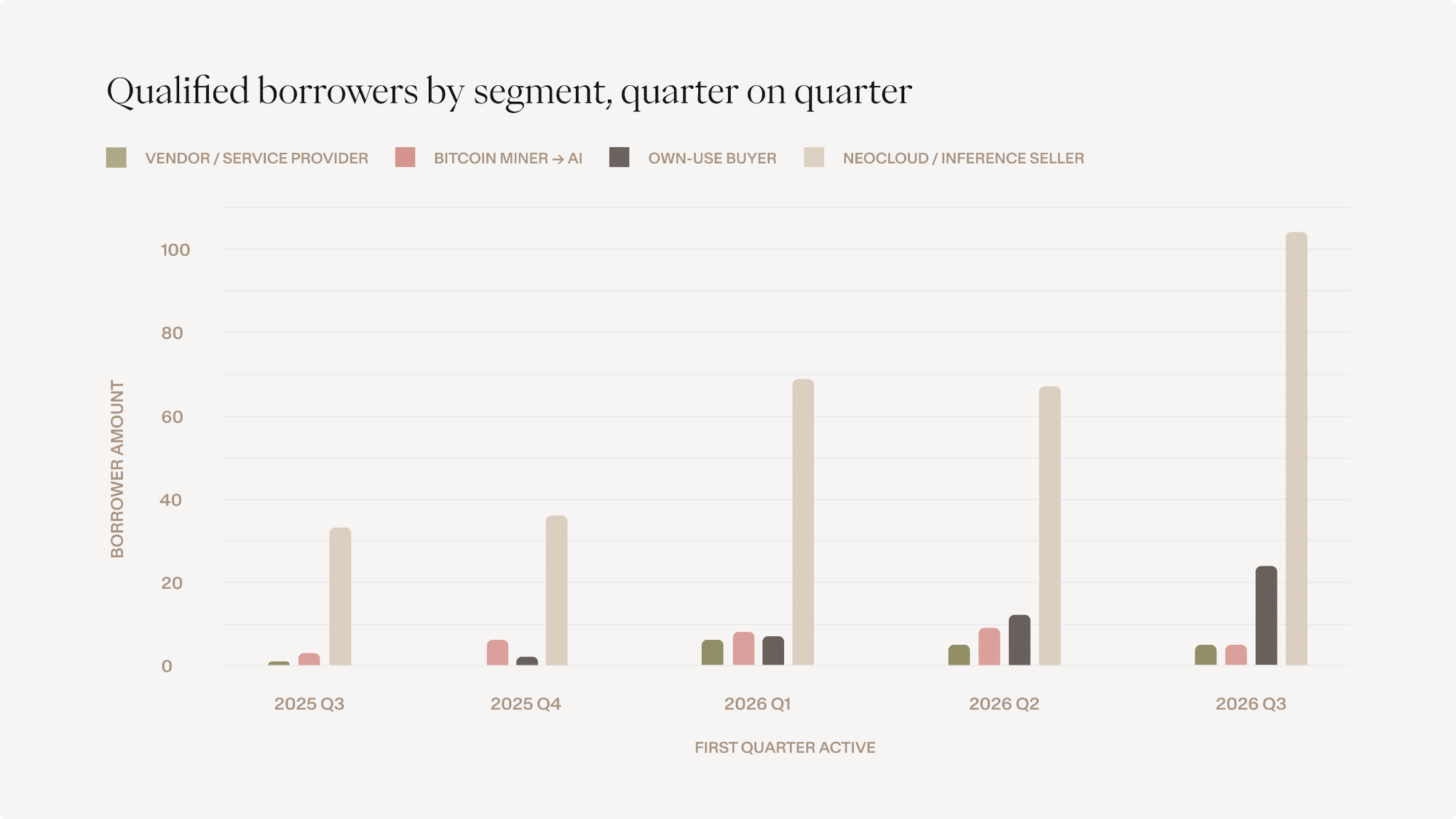
We expect this number to continue to grow, as rental prices continue to increase and demand for tokens grows exponentially.
From 300 Neoclouds to 10,000 Borrowers
This is the Compute Middle Market, and its biggest constraint is not power or chips. It is the cost of making a loan.
The biotech lab, the law firm, the AI-native software company whose cloud bill just went up by a third, they all need $25–200m of chips financed. And not so far into the future, we expect the 4th wave to be microclouds, 100,000 companies for whom a single server is enough, yet still want to own it.
The era of easy mega deal projects is over. Every single multi-billion dollar AI factory not yet under construction will face ever growing power, land, utilities, and notably, political constraints that will slow down their production.
The Compute Middle Market won’t face these challenges. It’s trivial to find 1–5MW of powered land/racks right now, and we don’t see that becoming a major constraint in the next several years. Small deals will proliferate and, surprisingly, will make the entire industry more investable. Instead of investors lending to a single mega-deal with a single offtaker, they’ll get access to a securitized basket of GPU loans, which diversifies risk, allowing lenders to lower rates across the board and ultimately creating a new investable asset class.
None of this happens without first bringing the cost of origination down for these smaller deployments. Bespoke GPU credit costs millions to issue, and that figure doesn’t change much whether it's a $50M, $500M, or $5B deal. Costs are the biggest impairment for lenders who want to issue debt to the Compute Middle Market.
What this market needs is a standardized GPU loan: underwritten in days, and cheap enough to make 10,000 times over.
Sources
- USD.AI internal CRM: qualified borrowers by segment, Q3 2025 to Q4 2026 (to 14 October)
- uvik.net GPU Price Index
- Yahoo Finance: CoreWeave pricing
- GuruFocus: CoreWeave's latest pricing move
- Inc.: CoreWeave capacity sold out
- Broadcom: Private Cloud Outlook 2026
- Digy AI: cloud repatriation in 2026 (Cloudera and Cast AI surveys, comma.ai)
- The Information: a16z, General Catalyst race to secure chips
- Dealroom: a16z and General Catalyst are becoming compute landlords
- KuCoin News: Silicon Valley VCs secure GPU capacity
- Upstarts Media: Andromeda raises $60M