
Underwriting and Risk Management


USD.AI generates yield through asset-backed credit facilities, where interest is sourced from over-collateralized loans to enterprise-grade GPU operators. Loans are structured as a senior secured position, ensuring depositor principal is protected by a first-priority lien on hardware and step-in rights for revenue-generating contracts. This post walks through how that works in practice: the programmatic standards loans must meet before capital deploys, and how risk is actively managed throughout the lifecycle of GPU-backed loans.
Who USD.AI Lends To
Target Borrowers
Common profiles include neoclouds and AI clouds with contracted revenue and former crypto miners transitioning to high-performance compute (HPC) operations who lack access to conventional bank financing at their deal size. Research institutions and single-server operators are also eligible where the hardware meets the collateral and structural requirements.
Underwriting Model
The underwriting process is asset-based, anchored by the liquidation depth of the hardware. While the team conducts rigorous institutional diligence on every borrower to assess operational risk, the primary credit anchor is the recoverability of the collateral.
Collateral Standards
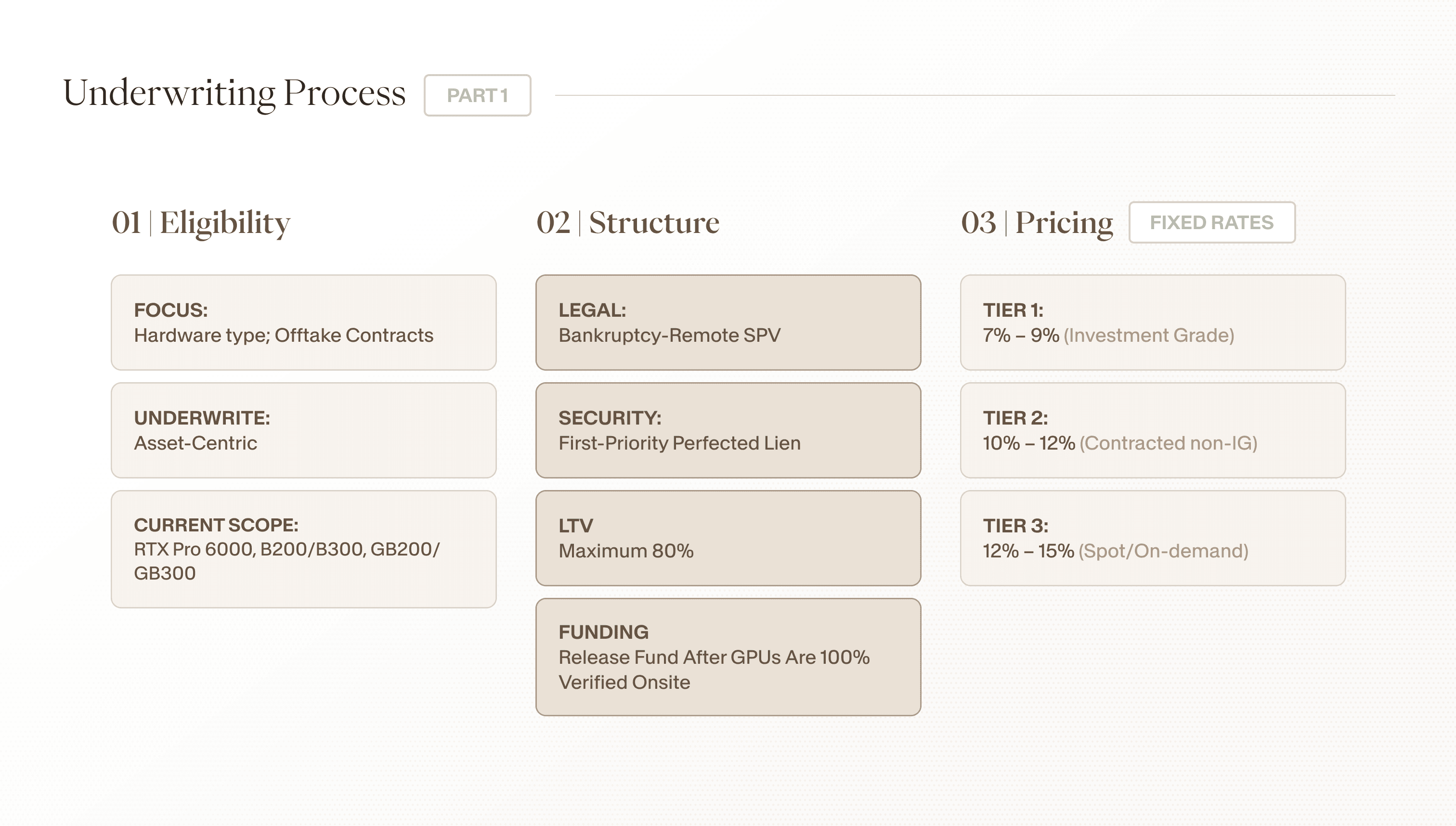
- Loan-to-Value: Hardware is valued at a maximum 80% LTV at origination.
- Eligible collateral: Limited to enterprise-grade NVIDIA GPUs including RTX Pro 6000, B200/B300, and GB200/GB300. Older generations like H100 and H200 remain eligible on a case-by-case basis based on contract revenue and liquidation depth.
- Facility: All collateral must be installed in a Tier III or Tier IV data center. Before any capital leaves escrow, the colocation operator executes a lien waiver granting USD.AI senior claim over the hardware ahead of any facility lien. Standard property and casualty insurance covering flood, fire, and theft must be in place at close.
Compliance and Jurisdiction
USD.AI only lends to jurisdictions where hardware title can be perfected and security interest enforcement is reliable; entities subject to OFAC sanctions are ineligible.
How Loans Are Structured
Legal Isolation
Loans are originated through a bankruptcy-remote SPV (a legally isolated entity ensuring the collateral can't be pulled into a broader insolvency of the parent company) that holds the GPUs, the offtake contract, the colocation agreement, and all revenue accounts.
USD.AI holds a first-priority perfected security interest over all SPV assets and 100% of the SPV equity.
The SPV cannot incur outside debt or file for voluntary bankruptcy without an independent manager's consent. This ensures that if a parent operator fails, the collateral remains isolated and does not become part of the bankruptcy estate.
Loan Terms
Loans are structured at up to 80% LTV against verified acquisition cost, with at least 20% borrower equity confirmed before any capital releases from escrow.
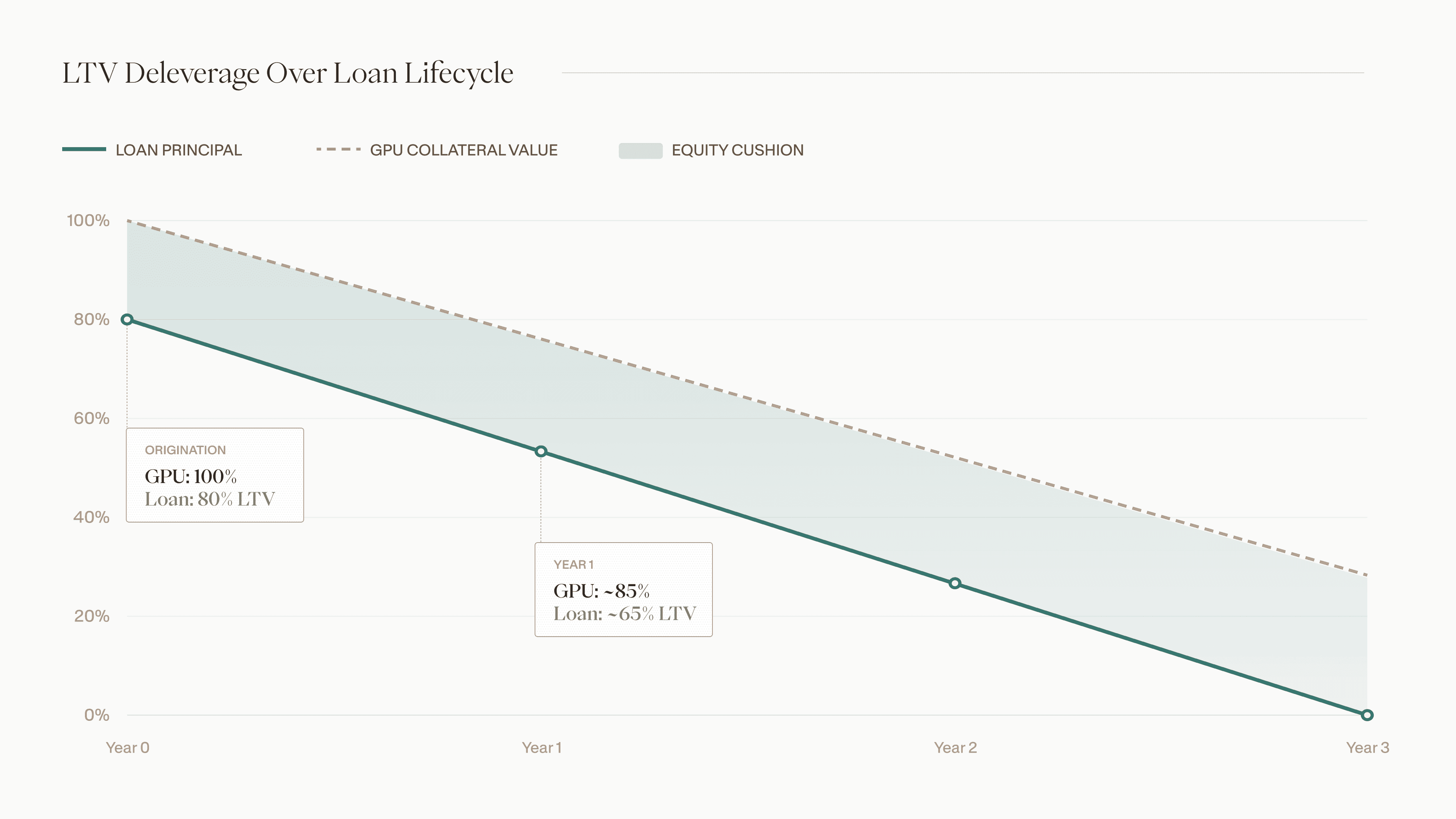
The standard term is three years, straight-line amortizing. Terms may extend to five years to match the duration of a specific offtake contract. The amortization schedule is calibrated to the GPU depreciation curve: a loan originated at 80% LTV deleverages to approximately 65% LTV by end of year one as principal pays down faster than collateral value declines.
Rates are fixed, and loans are prepayable without penalty.
Funding
Capital doesn't release until the hardware is delivered to the designated facility, physically installed, and verified on-site by an independent third party.
In the interim, loan capital is held in escrow at Wilmington Trust earning up to 7% APY.
Read more about how escrow with Wilmington Trust works.
How Rates Are Set
All USD.AI loans carry fixed rates. There are no floating rates, no SOFR-linked pricing. Rates are programmatically set at origination based on two variables: the quality of the offtake contract (a binding agreement where a counterparty commits to purchasing compute capacity at defined terms) and the loan-to-value ratio, not the creditworthiness of the borrower.
Tier 1 | Investment-grade: 7–9% per annum. Applies where the offtake counterparty carries an investment-grade credit rating (BBB-/Baa3 or above from S&P or Moody's), or where the borrower holds a customer default insurance policy covering the contract.
Tier 2 | Non-investment-grade multi-year contracted offtake: 10–12% per annum. Applies where the counterparty is not investment-grade but has executed a binding multi-year agreement with documented payment history.
Tier 3 | On-demand or spot rental: 12–15% per annum. Applies where compute is sold without a multi-year contract. Revenue is real but uncontracted; the rate reflects that variability.
Tier 1 and Tier 2 pricing require a minimum 24-month remaining offtake term at origination.
Borrowers who integrate USDai into their treasury or operations receive a rate reduction, with the discount deepening based on depth of integration.
Ongoing Risk Monitoring
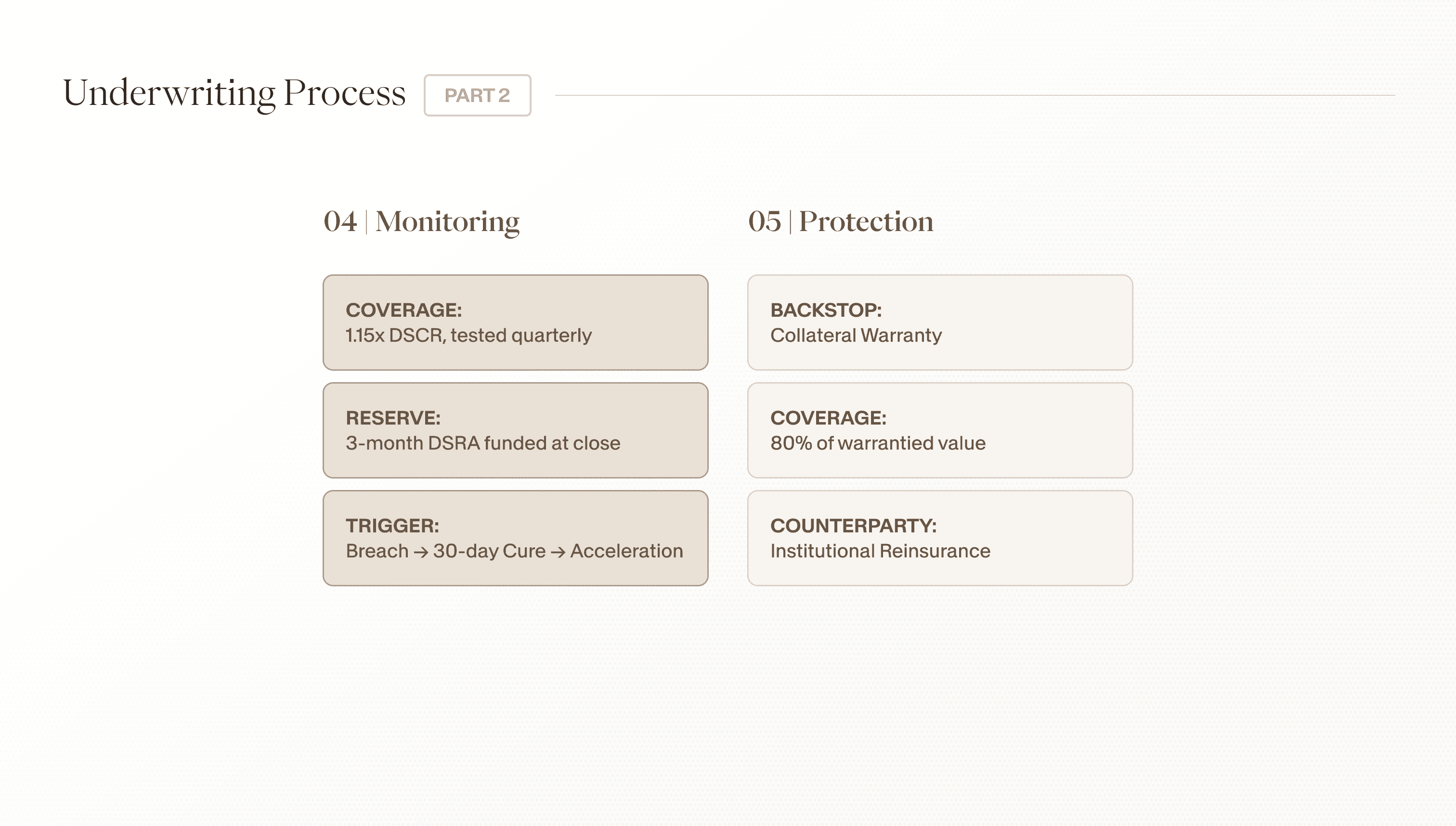
Risk management is a continuous process throughout the lifecycle of the loan. Loans are monitored quarterly against a minimum 1.15x debt service coverage ratio (DSCR), tested against trailing cash receipts under the offtake contract. The 1.15x floor means the borrower produces 15% more cash than is needed to service debt, absorbing routine operational variance without triggering a breach.
A three-month debt service reserve account, sized to peak scheduled debt service, must be funded from borrower equity at origination before any loan capital releases. The reserve must be replenished before any distributions flow to the borrower.
If a borrower breaches DSCR for two consecutive quarters, a defined remediation sequence begins:
- A 30-day cure period opens, during which the borrower must make a mandatory partial prepayment sufficient to bring the loan back in line with the required coverage ratio, funded either from the debt service reserve or directly from equity.
- If the prepayment isn't made within 30 days, the loan is in default. USD.AI accelerates the loan and moves to enforce against the collateral.
Collateral Protection
In the event that operational remediation fails and liquidation is required, the final layer of protection is a collateral warranty carried on USD.AI's financing, provided by Barkr, an AI-based collateral valuation service backed by institutional reinsurance. This ensures that even in a worst-case hardware market, the principal remains protected.
Read more about how USD.AI is working with Barkr.
At origination, Barkr establishes a warrantied value schedule for the GPU collateral over the life of the loan. If a liquidation event occurs and realized value falls below the warrantied schedule, the shortfall up to 80% of the warrantied amount is covered by Barkr's institutional reinsurance layer.
Read more about how sUSDai is fully insured now.
The warranty costs 150 basis points per year, netted automatically from the interest yield stream. It doesn't appear as a separate charge to the borrower and doesn't affect the stated loan rate.
Diligence Requirements
No loan closes without the following reviewed and approved:
- Corporate org chart identifying all entities and ultimate beneficial owners holding 10% or more
- Trailing 12 months of financial statements, audited or reviewed where available
- Evidence of equity contribution: wire confirmations and vendor invoices
- Executed GPU purchase order from an OEM or authorized reseller
- Executed colocation agreement
- Executed offtake agreement (or documented on-demand revenue history for Tier 3 borrowers)
- UCC, lien, and judgment searches confirming no prior security interests over the collateral or SPV equity
- AML/KYC documentation for all ultimate beneficial owners
- OFAC and sanctions screening for all entities and individuals in the borrower group
The Summary
USD.AI has deployed over $100M in GPU-backed loans and built a $1.2B pipeline in eight months . Loans are structured to isolate hardware value, ensuring that yield is backed by physical assets and principal is protected through every stage of the loan.
Read more about how loans are structured at: https://docs.usd.ai/borrower/overview.