
The USD.AI Thesis: Inference Will Dominate


When we talk with our community, one of the biggest misconceptions we hear is that only the latest generation GPUs hold value.
For Bitcoin mining, this is absolutely true. After 18 months, the chips are done. Zilch, can't compete any more.
The AI market is different.
Today, NVIDIA’s H100 is the benchmark for training frontier models. But demand for prior-generation chips such as the A100 remains strong.
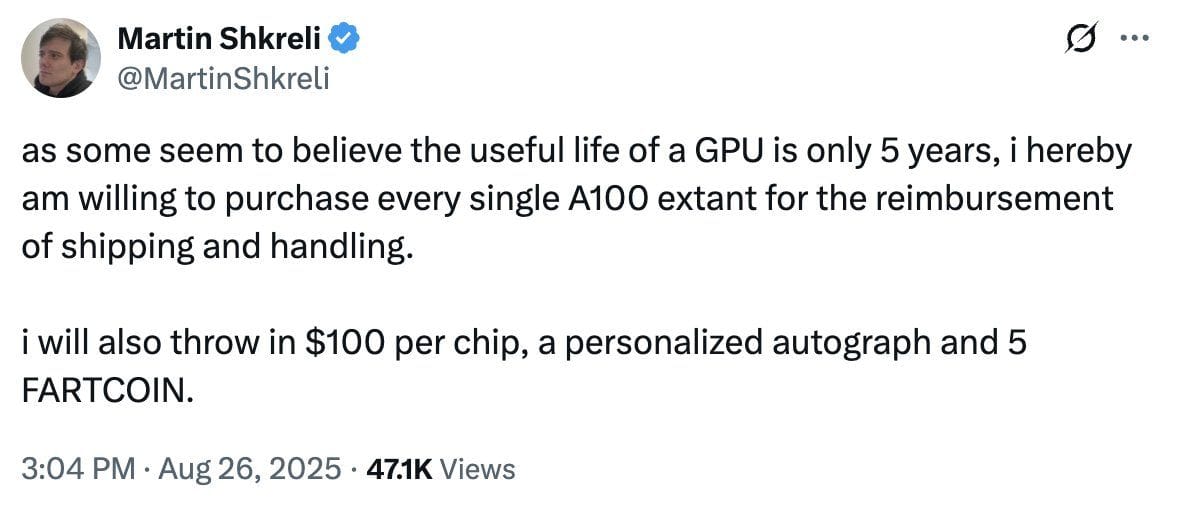
AI chips don’t become worthless the moment the next generation launches. Instead, their role changes.
- Training workloads i.e. developing new frontier models, require the latest, fastest, most expensive hardware. This is where hyperscalers like Microsoft, Google, and Amazon dominate, because training demands the scale, capital, and data infrastructure that only they can provide.
- Inference workloads i.e. running queries on chatbots, generating images, or serving real-time outputs, are a different story. Here, the hardware requirement is less about cutting-edge specs and more about throughput and cost. Companies care about response time and token generation, not which GPU is doing the work.
This distinction is why A100s, V100s, and similar “older” GPUs continue to generate revenue years after release.
Training Vs. Inference Demand
This is where the real opportunity lies.
Brookfield projects that while training makes up ~80% of compute demand today, by 2030 inference will represent 75% of global demand. Inference is not controlled solely by hyperscalers. It is met by smaller colocation providers, sovereign initiatives, and independent operators that often rely on prior-generation GPUs.

Even large Hyperscalers like Elon Musk's xAI are using cloud providers for inference.
Over the next decade, $7 trillion will be spent on AI infrastructure. That includes $4 trillion in GPUs and compute systems, $2 trillion in AI factories (data centers), and nearly $1 trillion across power and transmission. Hyperscaler capex alone reached $325 billion in 2024 and continues to accelerate.
The installed GPU base is expected to grow from 7 million units in 2024 to more than 45 million by 2034. Hardware refresh cycles occur every 12–18 months, so depreciation and replacement are systemic.
GPU-as-a-service is forecast to grow from $30 billion in 2025 to more than $250 billion by 2034, with operators earning 25–30% unlevered returns on GPU leasing.
As inference demand scales, the need for financing grows most acutely outside the hyperscaler ecosystem, in colocation centers, sovereign projects, and independent operators building the backbone of AI.
Depreciation as a Feature
Enterprise GPUs depreciate at roughly 20–30% annually. Secondary market pricing reflects this:
- A100 rental rates declined from $2.40/hour in 2020 to $1.40/hour in 2024.
- H100s fell from ~$4/hour at launch to $1–$2/hour within 18 months.
Hardware prices are a function of the rental income they can generate. Rates fell 50% on H100s, and prices on the secondary market also fell from ~300k to ~150k over the same time period. It's not a perfect 1:1 correlation, but its a good directional representation of the underlying value of the hardware.
Fast depreciation drives operators to refresh hardware on short cycles.
In the USD.AI protocol, loans are structured on a three-year amortization schedule, matching this refresh pattern. By the time a borrower repays a loan, they are ready for a new fleet of chips, and a new loan.
This structure creates speed and liquidity in the onchain loan facility.
On average, the protocol receives about 3-4% of the total loan balance each month across its assets. This allows the protocol to cycle quickly, adapt to hardware refreshes, and continually service the GPUs that are actively generating revenue.
It is not like financing a 30-year mortgage, which is an industry that's already been fully captured by TradFi, is heavily regulated and almost all business is run through the banks.
Instead, GPU financing is more like a three-year auto lease for a Mercedes: high performance, fast turnover, and continuous renewal. Banks are not in this business yet, and private credit has yet to optimize this market.
That turnover and open market opportunity is exactly what allows USD.AI to provide yield to stablecoin stakers, while financing the cutting edge of AI infrastructure.
Rapid depreciation and constant refresh cycles are not risks to be avoided but realities to be harnessed. The protocol's financing model is built for this future, providing liquidity for depositors, capital for operators, and fueling the global AI infrastructure buildout.
At USD.AI, our thesis is clear: inference will dominate.