
The Interest Rate of Intelligence

Written by David Choi (@0xZergs), CEO and Co-Founder of Permian Labs (developer of USD.AI). Originally published on April 22, 2026.
The mission of USD.AI and the roadmap for the next 24 months.
- Last 6 months: Found PMF in the neocloud sector + $10bn of volume traded
- First 12 months: The Interest Rate of intelligence (sUSDai) - lending layer
- Next 24 months: The Stablecoin of Intelligence (USDai) - settlement layer
- The end of SaaS: The “Iron Age” of Credit
The 2nd largest opportunity in AI is right in front of us
Nvidia is the #1 business model in AI, and getting close to $500bn of GPU sales 5 quarters.
The 3rd largest business is the LLM, where OpenAI makes $20bn a year.
USDAI is focused on disrupting the 2nd largest business in the AI sector today: debt.
Neoclouds are paying closer to $650-700bn for $500bn of chips, due to interest rate and other costs in order to purchase the GPUs at massive scale. This is a $150-200bn of financing costs, and clearly the largest industry after Nvidia, and 5x bigger than the largest LLM.
AI Capex is close to $10 trillion dollars in the next 5 years, all of which will be debt financed.
Hyperscalers can’t issue more debt (eg Oracle), private credit is in full retreat (because it’s illiquid). What’s missing is the ability to trade the debt of GPUs. This isn’t that dissimilar to what happened with wstETH and ETH staking - before Lido, ETH was just stuck in staking. Collateralizable derivatives solved the liquidity problem.
This also makes this the 2nd largest expense in the AI space, which is covered in the “Next 24 Months.”
Last 6 Months
Since its launch over the last 6 months, USDai has focused on demonstrating two things:
- Find borrowers: convince AI neoclouds to borrow stablecoins, even though they never touched a wallet.
- Generate traded volume in the secondary markets: $12 billion dollars traded
Both of these were achieved in the last 6 months.
Organic demand.
There has been enormous demand from emerging neoclouds with the fallback of private credit funds in the last 3 months, where USD.AI has been described as a “monopoly” in the sub $150m GPU lending space by participants in the space.
- Initially, the USDAI customer base started from doing $1-5m loans, but is now expanding to many of the BTC → AI HPC conversions such as QumulusAI, SharonAI, and other >$1bn NASDAQ listed brand name companies who want access to non-recourse, non-dilutive debt financing.
- These deals are typically >$80m (a 128 node) to start, and scale in these clip sizes, which is ideal for continuous NAV instrument.
Invent entirely new risk derivatives.
Invented a brand new value insurance product with Barkr & MunichRe to enable no-offtake lending structures, which were previously very difficult to finance.
- Credit risk was a concern.
- Insurance absorbs the risk through third parties. It's less yield, but bad debt is the worse outcome.
- The reason chip-owning companies are so big is that GPU depreciation isn’t really a thing; they’re hoarding the GPUs, so the collateral is anti-fragile to politics.
- If things like the helium dilemma in the Strait of Hormuz caused the collateral to appreciate a lot, the collateral is actually better. It ends up being countercyclical to geopolitical events.
- An underlying asset showing economically invariant demand. Military wants Claude Mythos. They want it for Palantir; there’s a fixed demand for GPUs regardless of what the economy does. If there’s a supply shock, the assets stabilizing the loans are quite pristine.
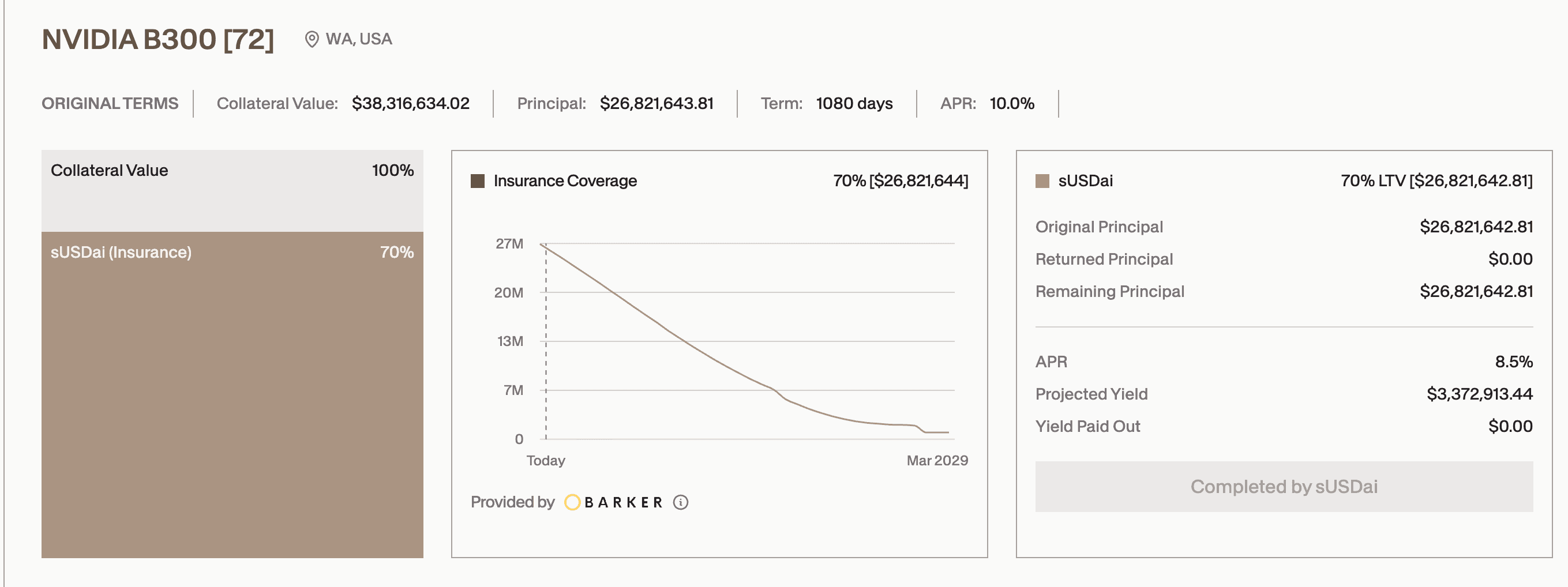
DeFi is dead? USD.AI is rebuilding DeFi by building AI.
This is why the next $10bn of TVL in DeFi will be GPU loans, and not unproductive onchain collateral with no economic basis.
sUSDai has a high interest rate because of the industry’s growth, not because of the mediocre credit quality. It is such a fast-moving market that borrowers are willing to pay a lot to access GPUs. And if shit hits the fan, there is 1) the economic argument that supply chain shocks improve the collateral and 2) an insurance business that will underwrite the risk.
- Clear business model: for $1bn of originations, our YE2026 expected revenues will be $25-40m via origination fees & net interest margin, participants are willing to pay to get access to the protocol’s liquidity product.
- Former CFO of Coreweave joins as Senior Advisor to structure larger scale deals (Evan Meagher)
- Strategic institutional fundraise & partnerships @ $300m FDV: TBA (NASDAQ-listed), PayPal partnerhsip (NASDAQ: PYPL), Coinbase Ventures (NASDAQ: COIN), and Banyan Ventures (AI-focused venture fund).
- Originations all happen onchain: over 40 institutional clients were onboarded on Coinbase Institutional or Paxos, with another 25 in the next quarters. This is also why Coinbase Ventures invested in the USDAI protocol, given the onboarding of non-crypto (companies that have never touched a wallet before) AI companies using blockchain rails to borrow money.
- Established the 1st Asia-Pacific focused GPU Financing platform with a major Asian special situations fund (TBA):
- This is the first-of-its-kind offering in all of Asia. Typically this would be a side category, but this is a specific desk with only 1 mandate: doing more expansion in Asia.
- The main milestone was the SharonAI deal, which is now the 2nd largest neocloud in the fastest growing Data Center space in Australia (>$1bn valuation), with USDAI mentioned as the primary financiers for this company, ahead of Cisco.
USD.AI has been mentioned in two S-1s in the last 6 months, with 5 more NASDAQ-listed neoclouds expected to follow in the next 5 quarters as material balance sheet disclosures.
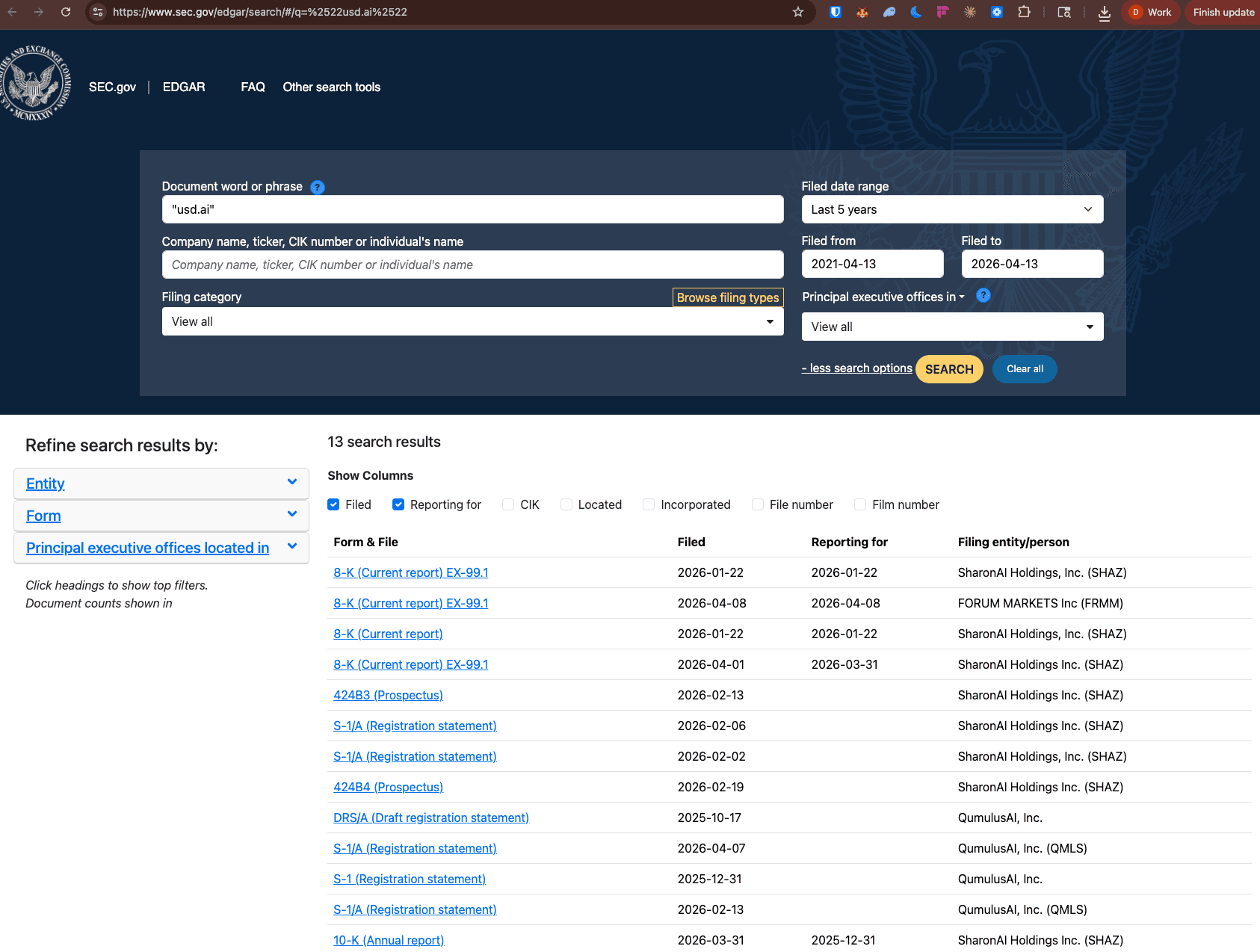
Search “USD.AI” on EDGAR on sec.gov
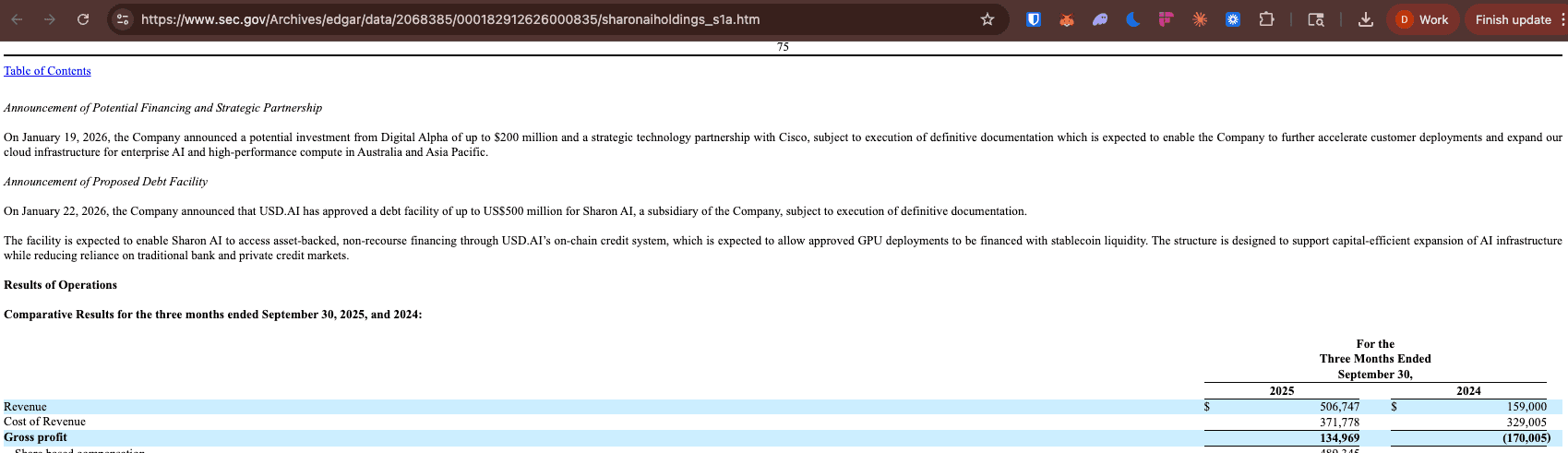
USD.AI was mentioned as the primary debt facility on the S-1 leading into SharonAI’s $1bn IPO. Source: www.sec.gov.
First 12 Months: sUSDai Becomes the Interest Rate of Intelligence.
sUSDai: Q2 2026 - Q2 2027
The objective of the first product is to build up a diversified loan book, in order to create the first public “interest rate” for intelligence. This means calculating what the cost of GPU ownership is by having a market clearing rate that the entire industry will look at as the reference rate. The target number is $1bn of loans originated (equates to ~$35m of revenue), or $1m of revenue per employee. This is all over the team’s internal dashboards as shown below.
Loans: $1bn of loans originated by the end of Q4 2026
- Ultimate goal is to fully disintermediate the neocloud business, where AI companies opt to go for a GPU mortgage rather than paying GPU rent.
- Eventually participants will no longer rent bare metal, but simply own chips as the “mortgage rate” is far cheaper than the “rental rate”.
- GPUloans.com, the origination platform has experienced a significant uptick of borrowers, and this is exemplified in the internal originations dashboard (see below). Q2 will have a significant onramp of loans, though expect some delays given that the entire GPU/Data Center industry is going through macroeconomic supply shocks.
USDAI has originated its largest loan to date, setting a new high-water mark for the fourth consecutive month. pic.twitter.com/OmYOkJAMnT
— USD.AI (@USDai_Official) April 8, 2026
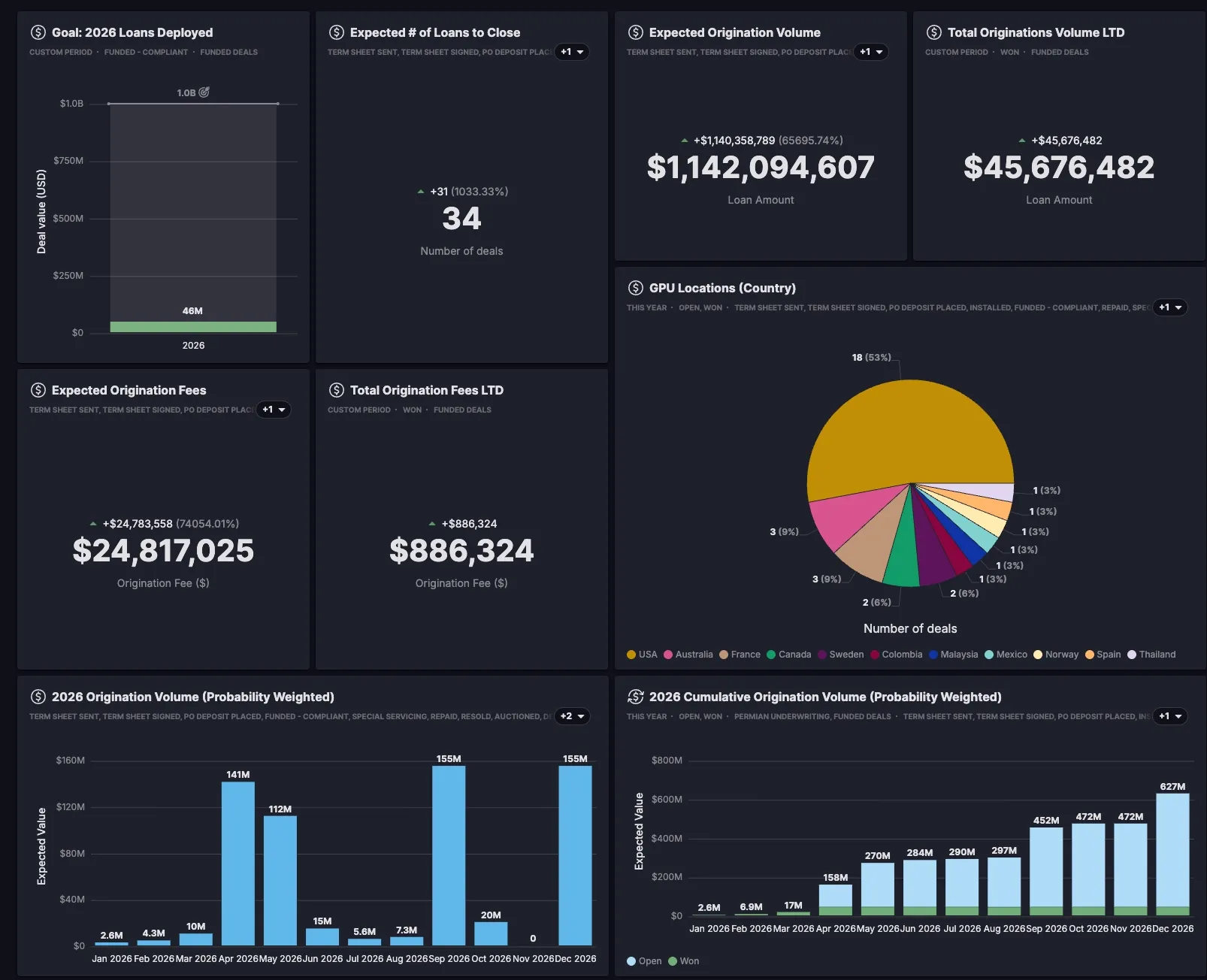
USDAI internal dashboard snippet of upcoming loans
Capital growth
- Currently, USDai is the highest yield-bearing stablecoin that has a yield >6.0% (~7% right now) with over $200m of TVL. The goal is to get this to over a $1bn with higher, scalable, demonstrated yields as utilization increases.
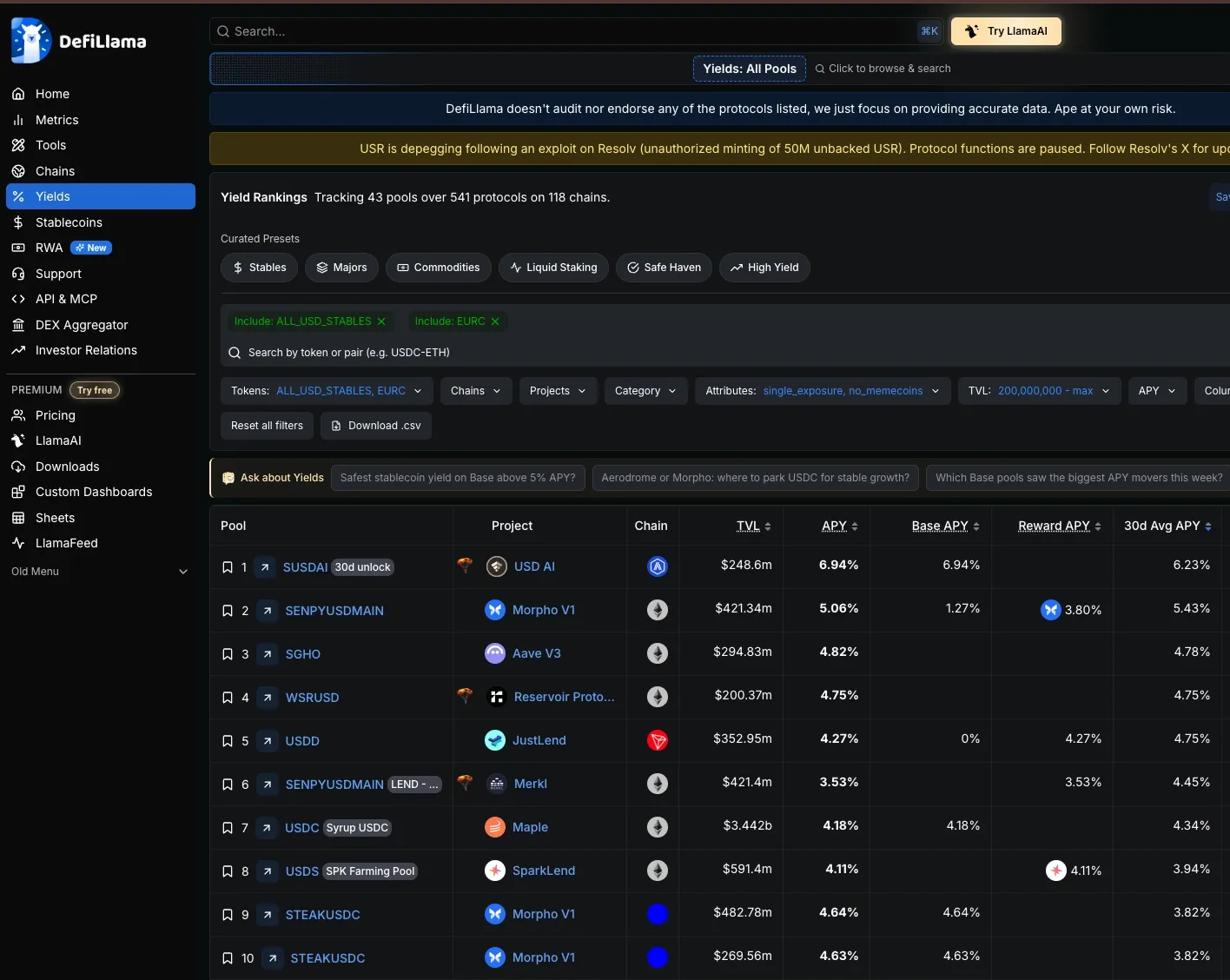
Source: DeFi Llama
- The goal is to take this positive carry through $10bn of deposits
1/ Today we're unveiling Obex's inaugural cohort.
— Obex (@obexincubator) March 25, 2026
8 projects to join the Sky Ecosystem.
$1B in capital deployment begins today.
Meet Cohort 1:
Maple | Securitize | Centrifuge | Daylight | USDAI | Better | River | TVL Capital
🧵👇 pic.twitter.com/UFFjvgtCcJ
- USDAI was recently approved for Aave v3, and plans to onboard in the next few weeks as the situation settles.
Two independent risk frameworks just reached the same conclusion: USDai and sUSDai belong on @aave@chaoslabs and @LlamaRisk have both published ARFC reviews recommending $USDai and $sUSDai as collateral on Aave v3 on @Arbitrum. pic.twitter.com/Tjw4DLlUeA
— USD.AI (@USDai_Official) April 3, 2026
Loan latency
Reduce latency of deal closing by making the borrow process completely automated (www.gpuloans.com).
A fully hands-off, automated signature process is expected to go live in Q2 2026, where any loan under $20m will have boilerplate terms that will let counterparties fully execute loans without talking to a single human.
The platform is also overlaying agentic underwriting to help with supplemental risk monitoring of the underlying mortgage.
Next 24 Months: the Stablecoin of Intelligence
USDai, the 1:1 PYUSD-backed stablecoin, has a critical role once the interest rate of AI is discovered. It acts as almost a “Trojan Horse” to the GPU industry: subsidizing one of the most expensive costs of the AI buildout to have agentic commerce settle in USDai.
It is impossible to envision a stablecoin in the AI Sector, without the concept of compute, as almost all costs in AI relates to compute.
Whether an LLM, an agent, inference, or a rental platform, everything is eventually being used to pay for the rent of GPUs, which pays down the mortgage/debt related to the expensive build out.
Case study: using USDai as a settlement asset to lower the loan interest rate by 25-50bps via the Debt Service Reserve Account
- In a recent loan, a borrower drew $9.8m in cash and was required to maintain 3 months of debt service reserves as part of the underwriting package. That reserve is a standard credit protection feature, but under USD.AI it can be held onchain in USDai rather than sitting idle offchain.
- By holding the reserve in USDai (not sUSDai) instead of in a bank account, the borrower receives a lower stated interest rate (50bps), while the incremental usdai minted increases earnings to sUSDai stakers. The loan went from 12% to 11.5%.
- This is an early example of usdai functioning not just as financing, but as an ai contract settlement stablecoin embedded directly into the credit structure.
- The next step is even more important. The goal is to move beyond reserves and have the rental agreement itself settled in USDai.
- That is the broader model: USDai first enters through reserves, then through repayments, and ultimately through the operating cash flows of AI infrastructure itself.

How a compute-tied stablecoin is the correct vehicle to win in the “agentic commerce” sector
The next proof-of-concept moves an additional step (left) on the diagram above: settling a GPU rental contract in USDai, to lower borrowing rates for borrowers:
USDai Membership Network
This is similar to a credit card but with “compute credits.” Settling in USDai lowers the cost for:
- agentic commerce action
- AI subscription (such as an API key)
- GPU rental ^[this is where the next stage is]^
- interest rate [PoC already completed with Ionstream, Crucible, and others]
Unlike credit cards, where interchange is the point of monetization, stablecoin yield comes from AUM rather than transaction volume. With so much capital locked in AI capex contracts (buildout, rentals, etc), this is an untapped resource that T-bill tokenization captures well, subsidizing one of the highest costs in AI today: GPU debt.
However to subsidize this, it starts with discovering this “interest rate of intelligence.” - which is the First 12 Months.
The End of SaaS… So What Replaces It?
The “Iron Age” of Credit.
This is not a niche lending sector, it's a complete replacement of how Private Credit is viewed.
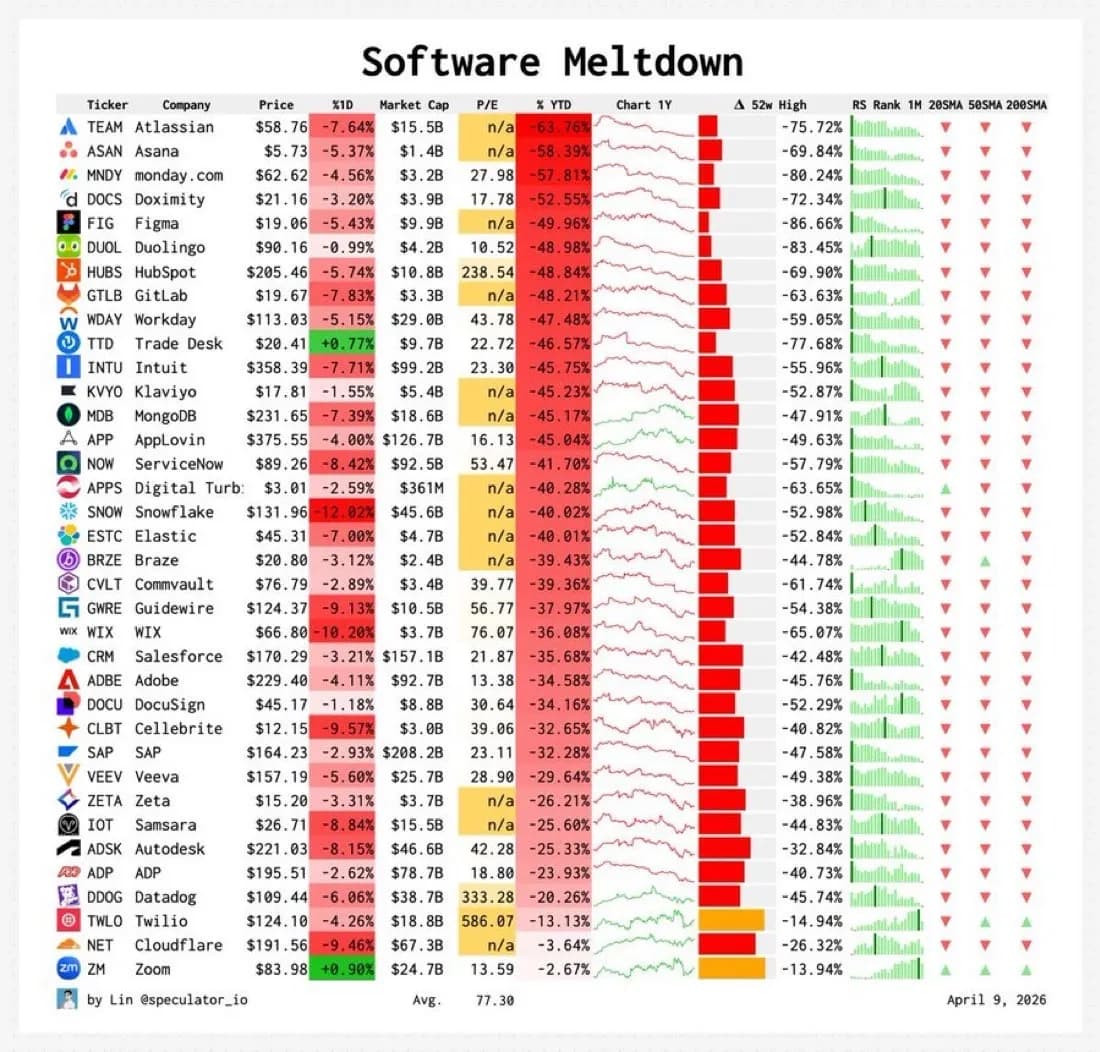
- Market conditions have changed. The last credit cycle was built for software. Falling rates, expanding multiples, and abundant leverage made recurring-revenue lending one of the cleanest trades in private markets. But that backdrop is gone. BlackRock now puts private credit at roughly $2.5T, with software exposure around $400B, and recent market commentary is increasingly focused on AI-driven disruption across those portfolios.
- The repricing is already visible. Public software has been hit hard as investors try to price what agentic AI does to application-layer margins and durability. The BVP Emerging Cloud Index now shows an average revenue multiple of about 5.4x, far below peak-era software levels. Recent reporting also points to broad software selloffs tied directly to AI disruption fears. Mythos only sharpened that anxiety by making automation risk feel immediate rather than theoretical.
- What replaces it is not another software lender. It is AI infrastructure credit. McKinsey estimates data centers will require about $6.7 trillion of capex by 2030. Deloitte estimates $500bn of global AI data center capex in 2026 alone, with more than half tied to chips, and increasing every year. That is where new borrowing demand is forming, where Nvidia estimates that ~20% is related to smaller financings (where USD.AI participates in with little traditional competition).
- That is why GPU lending should not be framed as a niche. Software credit was built around unsecured cash flow. AI infrastructure credit is built around hard collateral, rapid amortization, and assets that can be seized and remarketed. As growth shifts from SaaS multiples to compute buildout, the credit market shifts with it. The opportunity is not just to finance “GPU loans.” It is to finance the capex backbone of the AI economy.
- A paradigm shift is underway in how credit is viewed as an entire category: the old software-lending complex is being repriced, while AI infrastructure absorbs trillions of dollars of new capex. That means GPU-backed lending is not a side market. It is emerging as the most important credit category with real secular growth. In that world, protocols like USD.AI are not competing for scraps. They are positioning around the next dominant collateral asset class.
- A stablecoin purpose made for AI: Stablecoins have already proven to be one of the fastest-growing balance sheets in global finance, absorbing hundreds of billions of dollars into Treasury-backed structures, but Treasury bills are only the first asset class they were able to capture. The next and far larger opportunity is AI infrastructure itself, with more to be made in GPU financing than in Treasury bills auctioned.
In the coming years, more capital will be spent on GPU and data center capex than on many traditional financial products that stablecoins currently intermediate for Tbills, which is why USDai is being launched not just as a yield product, but as a settlement currency for GPU transactions, reserve accounts, rental contracts, repayment flows, agentic payments - because everything in AI does one thing: it pays down Wall Street’s loans. The goal is to prevent value from leaking out of the AI economy, keep those balances circulating inside the network, and use that monetary base to subsidize borrowing costs, support sUSDai yields, and help finance what is becoming the largest industrial buildout in modern history.